
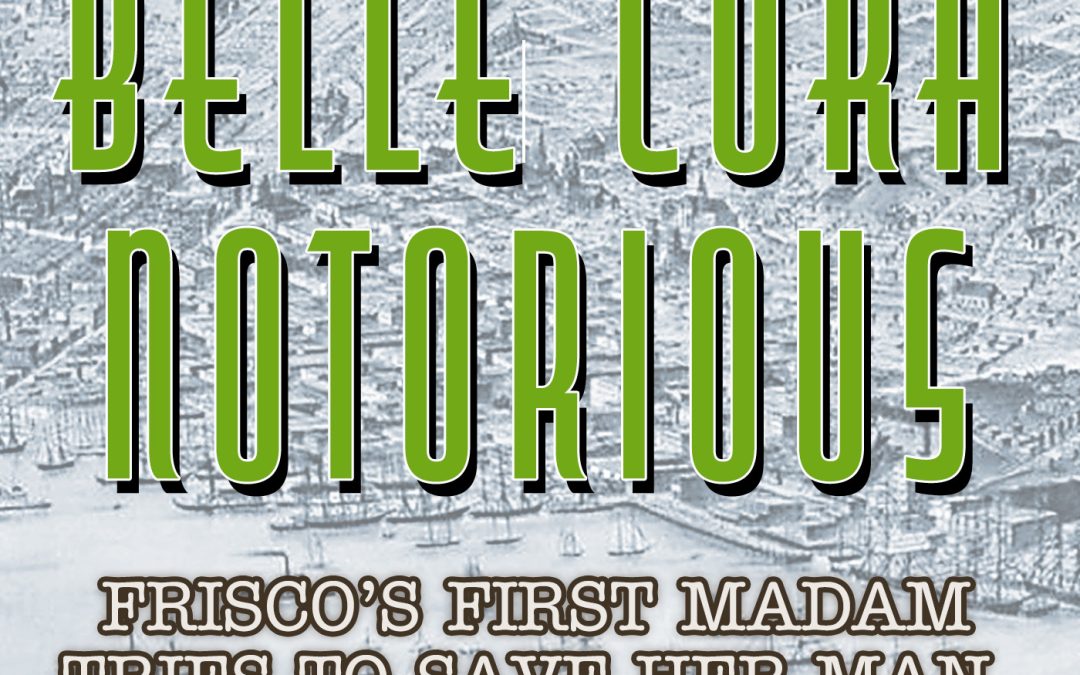
The city was young then, all bad whiskey, muddy boots, and men chasing gold like it was salvation itself. Meet Belle Cora, the most notorious madam west of the Mississippi. She came in hard from New Orleans with gambler Charles Cora and enough nerve to tame a town that didn’t scare easy. A sorry of crooked gamblers, desperate miners, abandoned ships rotting in Yerba Buena Cove, and a city where vice wasn’t hidden in alleyways: it sat right at the head of the table wearing silk gloves and diamonds.
Belle and Charles were the kind of lovers that only exist in old crime sheets and whispered stories after midnight. He was a hot-headed riverboat gambler with a pistol close at hand; she was sharp enough to build an empire in a town overrun by lonely men and easy money. Together they clawed their way from mining camps to the top of Frisco’s underworld, throwing lavish parties while judges, politicians, and merchants slipped through the front door after dark. Belle crossed paths with society queen Lavinia Richardson, and Charles tangled with U.S. Marshal William Richardson — a collision that would end with gunfire in a dark alley and a murder trial soaked in bribery and scandal.
Then came the reckoning. Newspaper wars, political grudges, vigilante justice — the whole rotten carnival rolled downhill fast. The feud surrounding Belle and Charles ignited one of the most infamous Vigilance Committee hangings in Frisco history, ending beneath the shadow of the gallows while church bells rang through the fog. It’s a story packed with doomed romance, corruption, revenge, and the kind of hard luck that built this town one coffin at a time. This is a bonus episode of Frisco: The Secret History. You can hear part of it free, but for the whole dark ride, head over to Patreon and subscribe.
Welcome to Frisco: The Secret History. I’m your host, Knox Bronson.
I have a great episode for you today, the story of one of the most notorious madams of the Gold Rush era in San Francisco, Clara Belle Ryan, or Belle Cora, the name she assumed from her paramour gambler Charles Cora. This is a bonus episode for Patreon subscribers. You can listen to part of it for free. To hear the whole episode, please go to www.Patreon.com/Frisco and subscribe.
[intermezzo]
We should talk a little about the history of prostitution in San Francisco.
As Sally Stanford wrote in her 1966 autobiography, “A Lady In The House,” about the 1930s in San Francisco, “The town was spinning just as lustily as it always had ever since the first pirate stepped down the gangplank from his ship, looked around, and ordered a passing Indian to bring on the women.”
I do want to mention that I know that it should be “Native American,” but this is historical podcast about real people and it is essential to convey how they spoke accurately.
[intermezzo]
Most of the prostitutes in San Francisco in THE pre-Gold Rush era were brown-skinned, Native American, Mexican, Chilean, Peruvian, with a contingent of French women who had traveled from a large French colony in Lima, Peru.
Writing on these last years of pastoral Yerba Buena—the city’s name would not be changed to San Francisco until 1847, a year before California became a state— a young Bostonian, Richard Henry Dana, Jr., wrote of Frisco women, in his memoir, “Two Years Before The Mast:”
[typewriter]
They dressed to be noticed, in gowns of various textures—silks, crepes, calicoes—made after the European style, except for the short sleeves, which left the arms bare, and the loose waists, corsets being not in use.
They wore shoes of kid or satin, sashes or belts of bright colors, and almost always a necklace and earrings. These styles prevailed except among the Indian women, who wore very little of anything, and often nothing above the waist.
There was a definite social hierarchy, he observed. Complexions, dress, manners, rank, all depended on one thing how much Spanish blood flowed through the veins.
The fondness for dress among the women is excessive, and is sometimes their ruin. A present of a fine mantle, or of a necklace or pair of earrings gains the favor of the greater part. If their husbands do not dress them well enough, they will soon receive presents from others.”
The women have but little education, and a good deal of beauty, and their morality, of course, is none of the best; yet the instances of infidelity are much less frequent than one would at first suppose …
If the women have but little virtue, the jealousy of their husbands is extreme, and their revenge deadly and almost certain. A few inches of cold steel have been the punishment of many an unwary man…
The difficulties of the attempt are numerous and the consequences of discovery fatal, in the better classes. With the unmarried women, too, great watchfulness is used. The main object of the parents is to marry their daughters well, and to this a fair name is necessary.
The sharp eyes of a dueña, and the ready weapons of a father or brother, are a protection which the characters of most of them-men and women-render by no means useless; for the very men who would lay down their lives to avenge the dishonor of their own family would risk the same lives to complete the dishonor of another.”
This is emblematic of Frisco’s attitude about prostitution. Permitted, tolerated, but there is line that will not be crossed in terms of acceptance into polite society.
Unpolite society, which made up most of Frisco’s population in those days, didn’t judge, didn’t care.
In 1857, Hubert Howe Bancroft would write:
“An aristocracy, in the common acceptance of the term, never has found a place in California. Vain and silly women have attempted cliques, have drawn round themselves lines of exclusiveness, and essayed the leadership of fashion; but all such efforts have had little interest to any except the aspirants themselves.” Bancroft was promptly dropped from honorary membership in the Society of California Pioneers, which still exists today.
Caleb T. Fay, writing of San Francisco in September, 1849, observed: “The only aristocracy we had here at the time were the gamblers and prostitutes.
That same month the first group of European immigrants arrived direct from France, aboard the Meuse from Le Havre and for the better part of a century San Francisco’s commercial sin would have a strong Gallic flavor.
J. A. Drinkhouse, arriving in San Francisco at the same time, wrote: “To give an idea how scarce women were, I will mention that when our vessel came into the harbor, we were boarded by half a dozen or more boats, and they all inquired if there were any women on board; they would give them two or three hundred dollars (almost $13,000 today) to sit behind a gambling table or fill some similar position.”
In the early Gold Rush era, women were scarce in San Francisco. Most were prostitutes. Men would pour out of saloons, so desperate for a glimpse of a member of the fairer sex, hats in hand out of respect, if a woman were to stroll up the street on the wooden sidewalks of the city.
Even as multitudes poured in after news of gold strikes in the Sierra Nevada spread around the world, the ration of men to women arriving was about twelve-to-one.
Another aside: By the end of 1849, roughly 500 to 600 ships had been abandoned in San Francisco Bay. This number continued to climb rapidly, reaching a peak of over 800 vessels by mid-1850.
This forest of masts in Yerba Buena Cove was created by the desertion of ship crews and their captains, almost immediately upon arrival to head for the Sierras. The harbor became a massive parking lot for derelict ships.
Rather than letting the vessels rot, some enterprising San Franciscans of found creative ways to repurpose them:
Many were dragged onto the mudflats and used as storage facilities. Others were converted into hotels, saloons, even a jail.
As the city expanded its shoreline, dozens of these ships were scuttled or sunk to act as the foundation for landfill.
It is estimated that 40 to 70 ships remain buried beneath the streets of San Francisco’s Financial District and the Embarcadero. If you stand near the Transamerica Pyramid, you are standing over the hull of the Niantic, beached there in 1849.
[intermezzo]
Arabelle Ryan and Charles Cora arrived in San Francisco, December 28, 1849, having sailed on the side-wheeler that departed Panama City on December fifth.
It had been an eventful trip. Charles and two of his gambler friends had confronted another gambler on the boat. Charles said, “I know you, you used to run a gambling game in New Orleans and you robbed everybody!”
The captain intervened and put an end to the ruckus. Charles and his friends had been harassing other passengers since since they had crossed the isthmus of Panama on their way to Panama City. This was the last straw. The Captain put them in leg irons until they promised to behave.
All the while, Arabelle guarded the $40,000 stake (a little over $2,000,000 today) they were taking to San Francisco to set themselves up in action.
Arabelle Ryan was born in Baltimore in 1828. She and her sister were orphaned in childhood. They both went to grammar school and in their teens went to work for a dressmaker, often delivering gowns to the hurdy-gurdy girls in a nearby bordello. Hurdy-gurdy girls were akin to the B-girls of the twentieth century, selling dances to men and getting them to buy them drinks at the bar. Most were not prostitutes.
The place was frequented by sea captains and Arabelle was enchanted with what she saw as the free-wheeling and carefree life of the women at the bagnio. It occurred to her it would be easier and more profitable to wear the dresses than to make them.
At twenty, she boarded a steamship bound for Charleston, North Carolina. She took up with a lover who promptly got himself murdered, so she hopped on another steamer to New Orleans.
A voluptuous young woman with thick brown hair, hazel eyes, and fair skin, she soon met Charles Cora, a notorious and prospers gambler born in Genoa, Italy. His family emigrated to America in 1817 and his parents abandoned him in the wide-open town in Natchez, Mississippi. A kind madam of a local bordello took the boy in and raised him.
By thirty, he had established himself as a gambler on the Mississippi River. He was of average height, heavy-set with rounded shoulders, had dark hair, a drooping mustache, and a hair-trigger temper. He was dedicated to sartorial splendor, like all the gamblers of the day, sporting an embroidered vest and top hat. He got into to trouble often, mostly for brawling.
Charles and Belle quickly fell in love. Foreshadowing their fate in San Francisco, Charles beat up a man who had insulted Belle. In return, the man turned them in for running an illegal gambling parlor. They were arrested and had to post a $5,000 bail bond, almost $200,000 today.
This was the Spring of 1849 and news of the gold strike in California had just reached New Orleans. They jumped bail and set off for the dream of riches in Frisco.
Upon arriving in the city, they decided to go further inland and took a steamer to Marysville, near Sacrament, gateway to the Sierra Madre, where the gold was. In partnership with one James Y. McDuffie, they opened a gambling hall and bordello called the New World.
“I remember seeing a bet of $10,000 made at poker by Charles Cora,” recalled one Forty-Niner who patronized the New World. “He won his bet.”
After a couple years in the foothills, having built up a very sizable stake, the pair returned to San Francisco.
“The Annals of San Francisco,” written by Frank Soul, John H. Gihon and James Nisbet and published in 1855 said this about the burgeoning city:
[typewriter]
San Franciscans were fast folk; none were faster in the world. Their rents, interest on money, doings and profits, were all calculated monthly. A month with them was considered equal to a year with other people. In the former short time, men did such deeds, and saw, felt, thought, suffered and enjoyed, as much as would have lasted in over a twelve-month period in other lands. But then these were really men–giants rather, the very choice of the cleverest, most adventurous and hard-working people of America and Europe. California was a hot-bed that brought humanity to a rapid, monstrous maturity, like the mammoth vegetables for which it is so celebrated.”
This is the city to which the pair returned. They fit right in. At this time Belle took Charles’ last name, Cora.
Belle found a wood-framed house at Grant Avenue and Washington Street and set up shop. By 1852, Belle was the leading parlor house madam in San Francisco, a distinction she would retain through out the rest of the 1850s. Her girls were the most beautiful in the trade; her prices were higher than any other house in the city. Her clientele was the creme de la creme of the wealthy city.
At the time, there were approximately one hundred bordellos in the City.
“The Annals of San Francisco” described it thusly:
[typewriter]
“Its curtains are of the purest white lace, embroidered, and crimson damask. Ali the fixtures are of a keeping, most expensive, most voluptuous, most gorgeous.
It is a soiree night. The ‘lady’ of the establishment has sent most polite invitations to all the principal gentlemen of the city A splendid band of music is in attendance. Away over the Turkish or Belgian carpet whirls the politician with some sparkling beauty, as fair as frail; and the judge joins in and enjoys the dance in company with the beautiful and lost beings whom, tomorrow, he may send to the house of correction.
Everything is conducted with the utmost propriety The girls are on their good behavior, and are proud once more to move and appear as ladies; vice hides herself for the occasion, and staid dignity bends from its position to twine a few flowers of social pleasure around the heads and hearts of these poor outcasts of society … “
Belle bought a fancy carriage in which she enjoyed riding around town with some of her beautiful girls and taking to the theater with Charles when he was in town. She lavished money on Charles, who would travel near and far to lose it in faro games.
His temper had not abandoned him. In October of 1852, he got into an argument with an infamous local gambler, Thomas Moore, at the El Dorado saloon in Sacramento.. Both drew their revolvers. Both opened fire, but Moore missed Charles and Charles missed Moore. The law showed up quickly and put them in jail. They were released on $1000 bond. Neither was prosecuted.
In the Spring of 1855, Belle moved to 27 Waverly Place on Lower Nob Hill. Her reign as Frisco’s foremost madam continued. By then the city was well on the way to being modernized, with houses and buildings replacing the tents of yore and gaslit streets paved with cobblestones. Miners and merchants sent for their families, bringing many so-called respectable women to town. They did not like Belle or any of the other madams.
Charles remained fiercely protective of Belle.
[intermezzo]
Here’s where it gets complicated. The funny thing about Frisco tales is that the town was still the size of a village, but a village of incredible wealth. People were pouring in from all over the world, most of them just passing through on their way to the Sierras to find their fortunes in the ground. Practically everyone who remained behind knew each other. There were rivalries. There was still not much law in Frisco. I refer you to Frisco: The Secret History episode 1: Vice Defined San Francisco’s DNA At Its Inception.
So the following tale contains an complex intermingling of three main rivalries, one between the Gambler Charles Cora and William Richardson, U.S. Marshall for the Northern California territory, one between Belle Cora and Richardson’s wife, Lavinia, and one between crusading publisher James King of William and another newspaper man, James P. Casey, although this one would kick in well after the other two were well in motion.
These rivalries would end in two murders, two hangings and two broken hearts.
This is a bonus episode of Frisco: The Secret History. To hear the rest of the story, please join me at http://Patreon.com and become a patron at the five dollar a month tier or higher. All of our main episodes are free, of course. I would very much appreciate your support so I can continue the research, writing, and recording of the episodes. I hope you find them both entertaining and edifying. Thank you.