
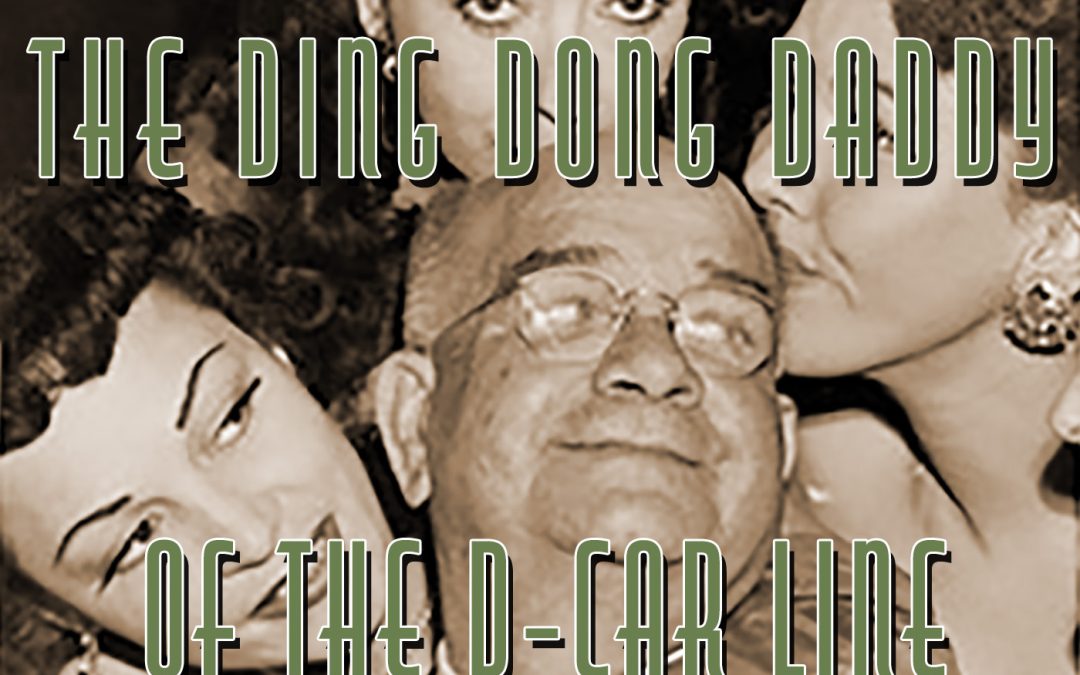
We are going to look at the life and times of little Francis Van Wie, the Diminutive Dutchman known also as the Ding Dong Daddy of the D-Car Line, the Car Barn Casanova, and the Trolley Toreador, and other nicknames. Francis managed to get hitched eighteen times over the course of his eighty-eight years. He rarely, if ever, bothered to get divorced. He did a stint in San Quentin for bigamy.
He started making nationwide news in 1915 at the age of twenty-seven and would continue to do so until he passed on from this mortal coil.
Francis covered so much territory over the course of his life, had so many jobs, told so many stories, and married so many women, as many as twelve concurrently at one point, it’s been a bit of a challenge to map his odyssey.
I believe I have gotten it right.
The headline on the front page of the Madera Tribune, August 19, 1952, shouted:
“Too Oft Trod Nuptial Trail
Leads Ding Dong To Jail”
Now, that is pure newsprint poetry.
The story read:
[typewriter]
The curtain fell today on Francis H. (Ding Dong Daddy) Van Wie’s brief career as a burlesque comedian when police led the portly, 66-year old Romeo off the stage and locked him up on bigamy charges. The officers said the Ding Dong Daddy of the D Car line had been wed far more times than he had been divorced.
The versatile Van Wie was right in the middle of an act at the EI Rey burlesque theater here last night when two men from the Los Angeles district attorney’s office walked in.
They had a warrant for his arrest, based on a complaint by Martha Moyle Van Wie, 67, of Long Beach. She was the latest woman to step forward and claim to have walked down the aisle with the ex-trolley car conductor. She said she had married Van Wie unaware that he had 15 previous marriages.
The latest misfortune came only a week after the chunky lover was locked out of a Los Angeles apartment by wife No. 15 after she also learned of his matrimonial past.
[intermezzo]
Who was Francis Van Wie? How did this 5’2”, 180 pound, roly-poly bifocal bespectacled bald bigamist end up on a burlesque theater stage surrounded by a dozen dancing girls who were clothed in not much more than conductor’s hats in 1952?
The rotund Romeo was born in the Midwest around 1887. At age 12, he left school to join the Barnum & Bailey Circus as an animal keeper. This was his story, anyway.
After a couple of years there, again, as he told it, he spent 14 years as a lion tamer for the Ringling Brothers Circus.
One of his tricks was to put his head inside a lion’s mouth. He passed out one night in a lion cage one night, next to a sleeping lioness named Old Mary.
Francis launched his matrimonial career in 1904 at age 18 when he married his first wife, Elizabeth Rebel.
He married Clara Heize in 1913 and had promptly disappeared.
In 1915, he made nationwide news for the first time. He was hired by a group of Chicago chiropractors who wanted to illustrate to students where the “big nerves” are located and how to treat patients through the spine.
The promotion centered on a fabricated case of amnesia. Francis claimed that his mind had been “blank” ever since a ladder fell on him in 1913. The chiropractors effected their back cracking treatments on him and he was miraculously and instantly cured.
With the local press in attendance, Francis clambered out onto an iron I-beam on the eighth floor of a Chicago skyscraper under construction and began yelling, “Where is Clara?”
The sensational event made headlines across the country, but it was quickly exposed as a hoax after Clara identified him as a faker.
Law enforcement officials viewed the incident as a stunt and slapped Francis on the wrist.
Climbing up on an eight story steel I-beam to perform for the papers? That takes some nerve and gives us a lot of insight into his character and innate showmanship, which he applied to animals and women alike.
The man was a natural, as we shall see. At the time, he had only one other wife, but he was getting going.
He married Edna Ruth Eastman in 1917, and Myrtle Harris in 1920.
In 1924, he married Mabel Joyce, his step-daughter from his marriage to his first wife, Elizabeth. Elizabeth had had an affair during one of his disappearances and had given birth to Mabel Joyce.
He was forty. Mabel Joyce was nineteen. For a time they had an act as mind readers and fortune tellers at the carnival.
She left him for another man in 1934 or 1941. There are sometimes conflicting event markers in the Ding Dong Daddy timeline, depending on which newspaper and which year and whom was interviewed.
Do you you remember the song “Papa Was A Rolling Stone” And the lyric, “Wherever he laid his hat was his home?”
That would be Francis. Some of his marriages lasted a lot longer than others. He had a propensity for disappearing for long periods of time, sometimes marrying during those interludes.
He explained a long absence to one wife that he was involved in secret undercover work examining the attack on Pearl Harbor. He told another that his investigator role required him to pose as a married man to other women.
The were other stories for other wives.
As is often the case when dealing with a vagabond Valentino like Francis, events, dates, timelines get scrambled and divining a coherent narrative is akin to reading tea leaves in a quantum cloud.
We do know that Francis first made national headlines in 1915, with the chiropractor stunt.
Francis continued rolling hither thither and yon, collecting wives as was his wont.
Several papers report him arriving in San Francisco in 1939, with Sadie Levin (Wife No. 8), describing her as a “blonde-haired woman” he met while in Chicago.
The Examiner, identified the woman as Julianna Elizabeth Voloshin (Wife No. 7), a “Hungarian born” woman he also had met in Chicago and married in 1941.
That same year, he donned the blue and brass-buttoned uniform of a municipal railway conductor at $43.20 a week, almost $800 today.
When he wasn’t ringing up fares on the trolley car, he wooed and won Sadie Levin Van Wie, Ruth Lecores Van Wie, Juliana Voloshin Van Wie and Myrtle Martha Wheeler Van Wie in quick order.
In 1944 alone, when streetcar crowding reached a wartime boom, Francis, of a most fatherly mien, married Mrs. Louise Weller Van Wie in January; Mrs. Josephine Bergman Van Wie in April and Mrs. Evelyn Brown Van Wie in December. He told his wives he was a confidential investigator for the government to explain his disappearances.
In 1945, a few of the wives discovered the existence of other wives, all of whom were still married to Francis. This got the attention of the authorities, who issued arrest warrants for bigamy.
Stanton Delaplane, a reporter for the San Francisco Chronicle, dubbed Francis the Ding Dong Daddy of the D-Car line in a front page story, and the moniker was picked up nationwide.
Readers were enchanted with the roly-poly Romeo’s exploits. It was 1945 and the war still going and a story like this was a welcome respite from the all grim stories of the day.
The sobriquet Ding Dong Daddy would follow Francis until his passing in 1973 and would guarantee that his future adventures would grab headlines until the end.
The Ding Dong Daddy of the D-Car Line was a meme before there were memes.
Delaplane had borrowed a Louis Armstrong song title for the sobriquet.
[ding dong daddy excerpt]
What a great song!
Delaplane wrote:
[typewriter]
Cupid’s memoirs rang up three more wives on the register of Francis Van Wie 58-year-old love-lorn Lothario of the trolley cars, former lion tamer and general man of good will toward women.
That made a total of eight marriages.
The gay conductor who did it all on $43.20 a week was last seen on Saturday as he left town aboard one of the street cars on which he had wooed and won five wives since 1941.
He left behind not only the wives. but three bigamy warrants as well.
From neighbors, wives, police and landladies, this appears to be the romantic record of “The Ding-Dong Daddy of the D Car Line.”
After 14 years of putting his head in the lion’s mouth, the dapper disturber of lonely hearts left Ringling Brothers’ circus and appeared in San Francisco with a wife named “Mabel.”
It was a hectic wedded life. Neighbors still remember the sentimental gentleman as he fled his Jersey street residence, battered and torn with the flame-haired artist’s model in wrathy pursuit.
Mabel beat the hell out of him. She also tacked another wife onto his record. The same neighbors remember that both Mabel and Van Wie said he had been married before.
That made two wives.
The Van Wie saga of wholesale wedlock has a blank space between 1932, when he shoveled for the WPA and 1939 when he was hauled into Municipal Court on charges of abandoning Mabel.
And in 1941 he appears again on the back platform of a San Francisco street car, where his love song soared above the clatter of pennies in the fare box.
In the irresistible blue and brass of a conductor, the debonair Casanova of the carlines led five brides in quick succession to assorted altars.
That made Van Wie the man with seven wives.
[end typewriter]
This story appeared in papers around the country, as more and more wives were uncovered and details of his peripatetic life revealed.
In 1945, he was arrested for bigamy.
As the newspapers and San Francisco DA Edmond Brown unraveled his story, the number of women he married increased from four to fourteen—all without a single divorce.
[intermezzo]
Awaiting trial, he tearfully poured out his soul to legendary Chronicle feature writer Carolyn Anspacher.
The headline read:
‘I Never Had a Home’
Van Wie Weeps for His Lost Ideal—
‘The World Is Making Fun of Me’
She wrote:
[typewriter]
A sad little man. looking more like a billiken than a Lothario sat in his Jones street hotel bedroom and wept.
Francis Van Wie is a very sentimental gentleman. And the tears that flooded his china-blue eves and then trickled down his cherub cheeks were salty memorials to his lost loves. Since 1904, he said, he has been seeking the perfect mate: the dream companion; the one woman in the world for him.
“I’m not a bad man,” he quavered. clutching a soiled handkerchief in pudgy paw.
“For 17 years, I was in show business—traveling from town to town never resting, never having a home.
“In 1938 I decided I couldn’t stand it any longer. I knew I had to have a real home and a real companion and pal.
“That’s the whole story. 1 just wanted a real pal …
The mere thought proved too much for the unhappy Van Wie. Tears again stained his convex spectacles.
“I’m no saint and I’m no angel. he sobbed. “Throughout my life I’ve made it a practice to go to church at least once A week. It didn’t make any difference what church: we all believe basically in the same thing and we’re all bound for the same place.
“My religion Is the Golden Rule.”
He peered over his glasses at Jake (The Master Ehrlich, who nodded owlishly. “Maybe made some of my twelve wives suffer.” be said. “But didn’t mean to, I didn’t want to hurt any of them.
Van Wie claimed he only turned to multiple marriages because he was “lonely and needed someone.”
“I worked hard every day and gave them all my money–while I was living with them. I gave them all my checks or cash.
And all the time I was searching for something I couldn’t find -the perfect pal.”
He gulped audibly and removed his coat, exposing a vest pocket crammed with cigars and a red toothbrush.
“The woman I wanted had to have the same ideals as mine. We had to like the same things, like to stav home evenings and play little rummy or pinochle and then maybe, go to bed at midnight. “
“I like movies. too, And whist parties. I don’t like dances.
“Some of my wives didn’t like these things. Some wanted to dance. And some didn’t want to go to movies with me, or play cards.
“Oh. yes, almost all of them were good cooks but that isn’t really important to me. I’m a plain common, working man and I like plain common food. None of that fancy stuff tor me. “
“And all the time I was looking for the perfect pal—and finally found Evelyn (who was Wife No. 12) and too late!”
Van Wile burst again into tears.
“She is my ideal come true and now I’ve lost her because the world is making fun of me.”
He rocked back and forth as if he were keening. Then he blew his nose vigorously and looked deep into the eyes of this lady interviewer.
“No.’ he said. “I’m not turned on women because of all this. Should I be?”
A tender silence filled the small room.
Van Wies’ round blue eyes in the!r dull gold frames grew larger and bluer and then seemed to swim in a misty film
The lady reporter twisted uneasily in her chair.
Outside the noon-day song of San Francisco was punctuated suddenly by the clang. clang, clang of the Jones street trolley.
The timing was perfect.
The ladv reporter departed.
It was the end of the line.
[end typewriter]
[intermezzo]
Francis was going to appear in court on charges of bigamy in the next couple of days. I guess his attorney, Jake Ehrlich, was hoping to effect some sympathetic PR for his client.
At the trial, Francis’s other attorney, James Toner, claimed that he was just harmless romantic, a sentimental, if impulsive fool, stressing that he did not harm them or run away with their money.
District Attorney Pat Brown, future governor of California, presented a different story, citing evidence that Francis had abandoned one wife and baby Francis Jr.—who was later adopted. Francis denied this—claiming he was sterile.
Brown said that Francis had been a horse thief in his youth and had once absconded with union funds, which would not go over well in pro-labor
Finally, Brown dropped a bombshell: Wife Number Five, Mabel, was really his daughter by his first wife. Van Wie respond that she was indeed the daughter of Wife Number One, but that he was not her biological father.
San Franciscans have always been mesmerized by a good storyteller, and Francis Van Wie was that and more. One wife recounted how he would turn up wearing an army uniform after being missing for a while. As his excuses unraveled publicly, the FBI bureau chief ’s ears perked up when he heard one wife say that in 1942 he told her that he was actually an FBI agent, dropping the first names of the local bureau chief and referring to the agency’s director as ‘J. Edgar.’
The Berkeley Gazette reported on January 29:
In an atmosphere of good will and congenial conversation, little Francis Van Wie, 58-year-old champion of multiple marriage, pleaded innocent today to two charges of bigamy filed by two of his estimated ten or possibly 12 wives, Emotionally overwhelmed by the combined efforts of nearly everyone in the jammed municipal courtroom to make him cheerful, Van Wie shed a few furtive tears in his brief preliminary hearing before Judge Leo Cunningham.
“I understand he was kind and thoughtful to the women he married,” said Judge Cunningham, addressing Evelyn, one of the complaining Van Wie wives.
“He certainly was kind to me,’ beamed Evelyn.
“And me too, Judge,” chimed in Mary, Evelyn’s co-complainant.
The bald-headed Lothario, listening to this effusion of compliments from the very people who called him a bigamist, drew out a handkerchief and wiped his misty eyes and chewed on a wad of gum.
Not only the Mesdames Van Wie were kindly. Judge Cunningham said nice things about the prisoner.
“Although he may have been generous in his accumulation of wives,’ said Judge Cunningham, “he never intended to harm anyone.’
The Judge scheduled Van Wie’s arraignment for Feb. 3 and set bail at $500 each on the complaints.
Van Wie arrived from Los Angeles yesterday, and the tote board at that time seemed to show 12 mates who had gone to the altar with the careless conductor since about 1911.
Alighting from the train, the connubial conductor, refreshed by the streamlined breezes of the Daylight Limited, announced that he remembered he had two more wives in addition to the 10 he confessed to having married previously.
On the train with Van Wie were two of his wives. Myrtle Deering and Josephine Bergman, vintage 1943 and 1944 respectively, The wistful conductor spent an acutely uncomfortable five minutes while the two ladies gave Him a piece of their collective and respective minds:’
Glaring at him. Myrtle gasped. “So!”
“So!” chimed in Josephine. “You were going to lock me in a closet, once, eh?”
Myrtle said “Now they’re going to lock you up. you-you-!”
“Pour it on, dearie,” Josephine urged.
The trolley troubadour of the D-Car Line said nothing.
At the city prison where Van Wie was booked, police inspected his personal effects which included a toothbrush for his false teeth, $49 in cash, a key ring with a lucky seven dice charm-and a box of headache pills.
[intermezzo]
But back to the trial.
He had been convicted on three counts of bigamy, so he appealed on grounds of insanity.
The Chronicle reported:
[typewriter]
Everything happened to Van Wie, the Ding Dong Daddy of the D Car Line.
He was kicked on the head by a mule.
He fell off a roof.
He was hit on the head with an ax and he fell 65 feet off a smokestack, And to these various raps on the noggin, the 58-year-old trolley. conductor ascribes the condition which led him into the hands of the law with three more raps-for bigamy.
Now, having been convicted on three counts of bigamy, Van Wie appealed for freedom and the leniency reserved for those who are not guilty by reason of insanity.
The five foot-two Toonerville Tornado clutched a handkerchief in his fist and his baby blue eyes looked sadly from Judge Kaufman to Wives Myrtle, Josephine, and Martha, who put the finger on him at the end of the honeymoon trail.
Van Wie was a sad sad sack.
He was born, he said, in Madison, Wisconsin in 1886 and his education was as hazy as his memory. He went to school for 11 or 12 years but never could get a graduation certificate from grammar school. He worked on farms, drove horses and learned to paint houses. But the .prosaic life was not for young Van Wie.
He found he had strange way with animals (as he later found he had with women), He became a Lion tamer for Barnum & Balley and for three years he cracked the whip in the center ring.
The army picked up Van Wie and gave him a military background and a medical discharge in 1917. From there he went back to show business as a mind reader with wife number five and one-time step-daughter, Mabel Joyce, did some more painting, got on the WPA in San Francisco and wound up on the back platform of the street car line, where his fare box serenade was irresistible to an illegal number of middle-aged ladies.
He said he experienced memory loss, forgetting a wife or two, and woke up in 1914 or 1915 in a firehouse and doesn’t remember the intervening years at all. (It was about this time that the law first laid hands on Van Wie; who had testified that he was cured by having his spine popped by a chiropractor. The law said it was part of hoax to have a bill, legalizing chiropractic, slipped by the Legislature.)
In 1915, a Wisconsin mine mule kicked him on the head, He hurt his knee on WPA. And a gang of bruisers boarded his street car one day and walloped him on the head some more,
All of this, said Francis, gave him more headaches. Defense Attorney James Toner wanted to know if he was ‘ever hysterical. “I get pretty excited sometimes,” said Van Wie. Was he a drinking man?
“No, sir,” said Van Wie.
He recounted a few arrests: vagrancy, A little embezzlement, nothing serious, some non-support cases, a charge of horse stealing.
And this was the end of his insanity defense.
The jury deliberated for 55 minutes before denying it on the second ballot.
He was sentenced to ten years, entering San Quentin State Prison on April 12, 1945, the day Franklin D. Roosevelt died. He quickly disappeared from the news … for awhile.
After two years, Frances was paroled, with a special condition that he was not to wed for five years without the approval of his parole officer.
[end typewriter]
[intermezzo]
In 1949, Francis approached the judge who had presided over his bigamy trial with a request to be allowed to marry again. After Judge Kaufman determined to his satisfaction that Francis was free to marry again, with all prior marriages seemingly annulled or dissolved, he insisted that Francis bring his fiancée into the court. When Francis and his fiancée, Mary Aba appeared before the judge, he advised her against marrying him. She insisted that she certain of her feelings. The judge relented and married them right there in court.
Marital bliss did not last long for Francis and Mary.
Stanton Delaplane wrote, in the Chronicle, on August 8, just weeks after their nuptials:
[typewriter]
Tearful (and somewhat toothless), Mary Aba Van Wie, Bride No: 13 of “Ding Dong Daddy,” left her husband’s bed and board yesterday for a rest cure. She was all worn out. Francis Van Wie, 62 years of unabashed amor, took to marriage No. 13 like an 18-vear-old, she said, “All he thinks about is love, love, love.”
The 50-year-old bride came to Superior Judge Herbert C. Kaufman, who married them just three weeks ago and sent them happily to a love nest at 574 23d street in Oakland. She had six teeth pulled only a few days ago, she said, and had been feeling poorly. But the former streetcar conductor accused her of being cold.
“He won’t even give me a chance to get well,” said Mrs. Van Wie. Also, she complained, Francis has been strutting around the bars. “He thinks he’s a big shot.” Mrs. Van Wie said patrons at the bar. where Francis is A night porter, insist on buying him drinks.
Judge Kaufman, who gave Francis his San Quentin vacation as well as his 13th bride, suggested: Mrs. Van Wie go and live with a girl friend until she gets in better condition. He said he would speak sternly to Francis.
“However,” said the Judge, “I think this is a temporary rift, a minor thing. All Van Wie has “is wife trouble.”
Delaplane concluded:
That is all Francis has ever had.
[rimshot]
[end typewriter]
He married two more women, Martha Moyle and Amelia Pritchard in 1951.
This guy was like a honey bee buzzing from flower to flower in the springtime. Almost impossible to follow this many years later. Like I said, the quantum cloud. I’m not sure how many wives he had at this point. Four, for sure. Does it really matter?
He was now, of course, famous.
Everybody knew the story of the Ding Dong Daddy of the D-Car Line. The media, since 1945, had turned him into a sex symbol, as much as a weepy-eyed, at least in court, short, bald, fat, dentured and bifocaled man could be.
In 1952, a theatrical producer pitched Francis on starring in a burlesque act entitled “My True Love Story” wherein he would tell the story of his many wives, wearing his conductor’s uniform, while a harem of dancers who wore conductor’s hats and not much else danced around him.
Of course, he jumped at it.
The Examiner reported:
[typewriter]
Francis H. Van Wie, San Francisco’s original Ding Dong Daddy, made a triumphant return last night to the Bay area, scene of his many matrimonial adventures.
As befits a man of his accomplishments. the ever-loving former Casanova of the carbarn was greeted with applause and half a dozen chorus cuties.
The girls put on a show of excitement that was accepted with quiet dignity by the little man who has fifteen marriages and considerably fewer divorces to his credit.
He also was back in the territory of Wife No. 14, who apparently is still married to him despite the fact he married No. 15, a Los Angeles widow. early this month.
[end typewriter]
The show lasted just a few nights with standing room only crowds at the EI Rey burlesque theater in downtown Oakland.
On August 8, the show was raided by Los Angeles police who had traveled to Oakland to arrest Francis once again for bigamy.
“1’11 fight it to the bitter end.” Francis managed to blurt out as he was led off the stage. His pronouncement was roundly applauded by the theater’s enthusiastic patrons.
He spent six months in Los Angeles County JaiL He was released in 1953 on condition he remain unmarried for seven more years.
He didn’t make it.
Jane Puckett in 1957.
Minnie Reardon in 1959.
He was back in jail again in Los Angeles in 1959 for violating probation.
Wife No. 18, Minnie, who was 81, called him a model husband.
The happy couple moved to Elsinore, in Riverside County.
Aug. 7, 1963, with Minnie by his side, he died at the age of eighty-eight. As a World War I veteran, he was buried at Ft. Rosecrans National Cemetery.
Strangely, his passing was not reported anywhere, odd for a one-time nationwide celebrity.
[intermezzo]
What was the secret of Francis Van Wie’s success with women? It wasn’t looks or money, obviously.
In 1945, while awaiting one of his trials for bigamy, a young woman from the Los Angeles Herald Examiner, Norma Barzman, interviewed Francis in custody.
The headline read:
Van Wie Tells Secret Of Wooing Successes
And the story went:
[typewriter]
(Wee Frankie Van Wie, the little man with the big woo, gave away his great trade secrets yesterday. Waiting in a Los Angeles jail for Police Inspector Jeremiah Desmond to arrive and escort him back to the many San Francisco women whom he wooed, won and wandered away from, he poured out his technique to a girl reporter for The Los Angeles Examiner. Here is the story.)
By NORMA BARZMAN
“You’re a woman. I could get you to marry me in a month.” I was shocked. The man who said this was far on the wrong side of 50, round as a beer barrel, pale and meek looking, with a shiny bald head and eyeglasses.
But then I remembered. I should expect anything, This was the “Carbarn Casanova.” Francis Van Wie, the 58 year old trolley conductor, was saying that, if he wanted to, he could even make me leave my husband and marry him in a month, or less.
“How?” I asked.
“Women want a home and security,” the trolley troubador answered. “They want to be told they’re loved more than anything else and they want their own way.
“When I met a woman thought was at all possible I courted her. “I gave them all presents- little trinkets to show I thought about them—candy and flowers—you know.”
“I’d take ’em to nice restaurants and shows and spend all my money on them.
“It’s simple. If I wanted to get you to marry me, I’d help you cook dinner some night and I’d make you feel how cozy and secure home can be.
“Older women are the ones who particularly like to feel secure. They want to feel they’re building a home and just starting out like a 16 year old bride.”
“But, Mr. Van Wie,” I said, “you’d have to do a lot more than help me cook a dinner to convince me I should marry you”
”Well.” he said, “I guess it’s my manner that has helped me. “Besides, I never criticize & woman. I don’t try to make her over at least when I’m courting her.
I take her at her face value and I do what she wants.
“I do anything they want- except-well, I won’t dance. I think if had been willing to dance could have made friends with more women.”
I couldn’t help smiling. Here was this cross between Victor Moore and Uriah Heap telling me he could probably have married more women if he’d been willing to dance.
“For me, you’d probably have to learn to rhumba,” I said,
“No,” he said and almost laughed, “You’d give up dancing for me. There’d be so much else to compensate.
“Well, might have a little difficulty with you,” he admitted, “because you’re so young. But my women were all near fifty and that’s an easy age to handle.
“I told them all I loved them although Evelyn was the only one I really loved,” he added. (Evelyn was Evelyn Brown of San Francisco, his bride of less than a month.)
“How did you propose to them?” I asked.
“Differently to each one,” he replied. “But the line I used most was let’s build a new life together.’
And I paid my women so many little attentions,” he continued. “I didn’t let them sit there waiting to have their cigarets lit. I lit them quickly and while I did I looked into their eyes and smiled.
“I helped them order dinner in restaurants-I suggested drinks they’d never tried–and I tipped big. Maybe they were impressed.”
“It must have been more than that°” I queried.
“Well,” he answered, with suspicion of a gleam in his eye, “maybe there was. I’m an affectionate man. I need affection and I give affection.
“You mean you’re a good lover?” I asked.
The gleam grew a trifle and became almost a glint.
“I’m no Romeo” he. said, “but I know how to make s woman feel as it she’s the only woman in the world and I’m the only man.”
“If any of my occupations made women like me it was being a streetcar conductor. It was a position of authority and seemed to represent standing in the community. It was a very respectable job and they thought they could be sure of getting my weekly pay check.
“Do you like me?” he asked eagerly. “It’s too bad I have to go back to San Francisco tonight with the police,” he said. And then the glint returned. “If I were going to be in town for about a month …
[intermezzo]
Francis was not a good man. He treated women poorly. Abysmally would be a better word. He was a charmer, seducing women and men alike into believing he was just simple love-lorn romantic. In the last months of World War II, his story burst across newspapers around the country, a wonderful diversion.
Delaplane’s Ding Dong Daddy of the D-Car Line appellation lent a comedic air to his betrayals.
What was funny? His looks and not much more. He left behind a trail of broken hearted brides over six decades, all of whom had married him in good faith.
In 1994, twenty-one years after his death, the Cherry Poppin’ Daddies, an enduring swing band out of Oregon, released a song about Francis, “Ding Dong Daddy of the D-Car Line.”
[insert excerpt]
A great song!
In his last interview in 1959, Francis said: “I don’t remember them all. I’m sorry. But I loved every one of them when I married them, every one of them.”
I’m sure he believed it.