
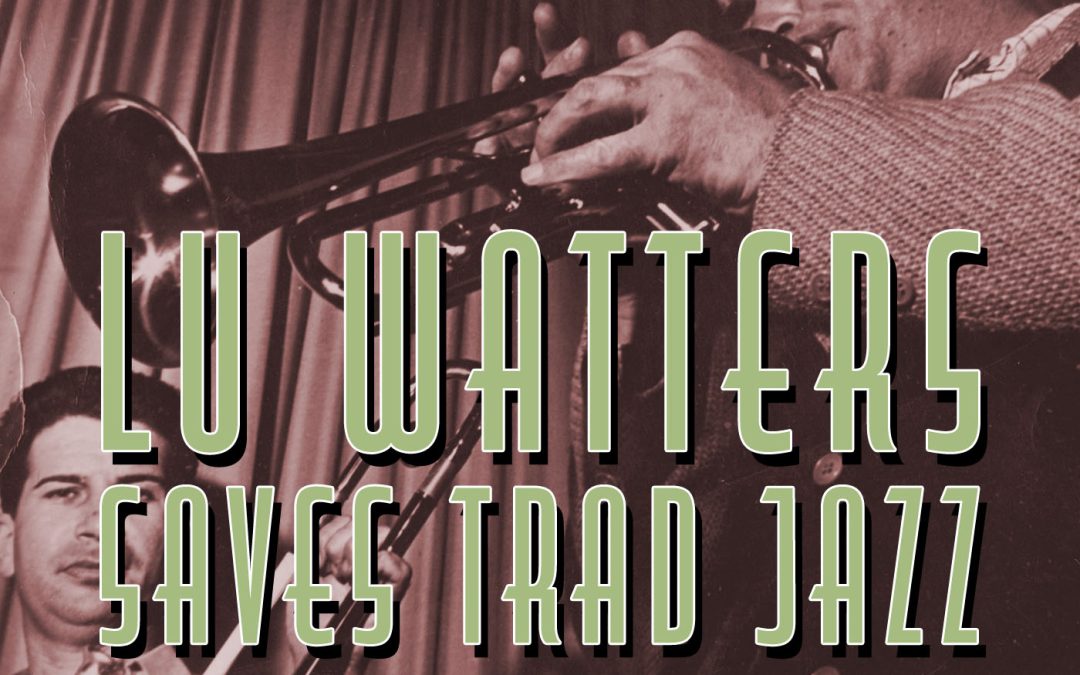
In this episode, I interview drummer and jazz historian Hal Smith. We discuss the music scene in San Francisco in the 30s and 40s and how one man, Lu Watters and his band The Yerba Buena Jazz Band, saved traditional jazz after the emergence of swing music. The musicians, the clubs, and how an girlfriend’s irate father with a pistol put Lu and his band on the front page, launching their career.
All in all, fascinating story!
(Knox) Welcome to Frisco: The Secret History, a podcast.
We have a great episode for you today. I’m talking to Hal Smith, a musician and jazz historian, and we’re going to be talking about some music from the era of the 30s and 40s in San Francisco. Hal, how are you doing today?
(Hal) I’m doing well, Knox. How about you?
(Knox) I’m just fine, thank you. I know you’re a musician and a writer.
Do you want to give the audience some of your backgrounds before we get into it, please?
(Hal) Sure. I’ll do a thumbnail sketch. I’ve been a fan of San Francisco-style jazz since the early 1960s. The first live music I heard was the Firehouse 5 Plus 2, which was—that group was influenced by the San Francisco style as—basically invented by Lu Waters and the Yerba Buena Jazz Band.
And I’ve been a fan ever since, and I’ve played it, and I’ve met most of the people who were involved with bringing that music into prominence. And some of them were very good friends. I’ve not only played with them, I’ve recorded with quite a few of them. And I’ll always be a fan of the music that came out of San Francisco in the late 1930s into the 1940s.
(Knox) So when did your interest in that era begin?
(Hal) I had heard the Firehouse Five with two cornets play at Disneyland in 1964. And I was playing with a group of young musicians and happened to mention how much I liked that two cornets sound. And one of the young musicians said, oh, I think my dad has a record with two cornets. Let me find it.
And he pulled out a record by Lu Waters’ Yerba Buena Jazz Band and put it on. And that was all it took for me. I was hooked. And that was 1965 when I heard the Waters Band. And I’ve been a fan ever since.
(Knox) Cool. Now, you have a couple of books and you have a website, correct? That’s correct.
(Hal) I’ve helped to edit a book. I was one of the editors on a book that was the autobiography of Danny Alguire, who was the cornetist with the Firehouse Five Plus Two.
And I also co-wrote a book with Chris Reed, who’s a British author. And we wrote about Clancy Hayes, who was one of the main figures of the traditional jazz revival in San Francisco. And those are both uh listed on my website which is halsmithjazz.com.
(Knox) Okay great we’ll we’ll put all those links in the show notes for anybody who’s listening. So i’ll get those from you later yeah great when did you do those books? Are they fairly recent or …
(Hal) Yes they are they’re the last few years and the the clancy book came out last year.
(Knox) And you’re you’re you’re a working musician
(Hal) Also correct, yes. I lead several traditional jazz bands, and I still work as a sideman in other groups.
(Knox) That’s very cool. And you’re in Arizona now, correct? Do you travel from Arkansas? Mm-hmm. Oh, wow. Oh. Well, I’m an idiot. It’s not Arizona. Okay. Is there a vibrant music scene down there?
(Hal) There is, but it’s not the type of music I play. When I am playing, I’m on the road almost all the time.
(Knox) Oh, okay. Great. Well, let’s talk about your area of expertise, which, as I understand, is one particular artist and a couple of nightclubs in San Francisco in that era.
I’m going to let you just talk for a while. If I have a question, I’ll wait till you take a breath. How about that?
(Hal) Okay. I think one of the most important nightclubs in the San Francisco music scene was the Dawn Club. That was on Annie Street beside the Palace Hotel. And during Prohibition, it was a speakeasy. And later in the 1930s, it became a swing and jazz venue.
They had both white and African-American bands playing there, but not any mixed bands because San Francisco had segregated musicians’ unions at that time. But still, they managed to have some good New Orleans-style bands. The Kid Ory Band played there in the 1940s.
Bunk Johnson from New Orleans was scheduled to play with the Yerba Buena Band one time, but the union nixed that, said you can’t mix the band.
And Lu Waters had to tell Bunk, I’m sorry, Bunk, we can’t make it work. And Bunk said, but Lu, I’m an Indian. Couldn’t get around it. But the club was well established.
And it was the perfect place for Lu to bring his Yerba Buena jazz band in the early 1940s. He’d been leading a big band that was patterned on the Bob Crosby Orchestra. And they played at Sweet’s Ballroom in Oakland. And it was a very good, hot, hot jazz band. But still, a lot of the musicians he worked with liked the older style.
The music was played by King Oliver’s Creole Jazz Band, Louis Armstrong’s Hot Five, Jelly Roll Morton’s Red Hot Peppers, and they liked playing songs that had multiple strains, like rags and marches and stomps, that were very different from the swing music that was being played at that time.
And after hours, a lot of musicians led by Lu Waters, including people like Bob Scobie, Turk Murphy, Ellis Horn on clarinet, Wally Rose on piano, friend of Peter Minton, by the way, and Clancy Hayes and others would go up to the Big Bear Tavern in the Oakland Hills and play these older songs after hours for their own enjoyment. And eventually they started thinking, why don’t we try and do this more often as a small band and see if we can make a go of it and not depend on a big band to play our music.
So that’s what happened at the Dawn Club. The Yerba Buena Jazz Band played there, just played a concert, and was very well received, and were invited to play again. And they were doing very well playing the older styles, the Auger and Armstrong, Morton, and printed programs of what they were going to play that night and handed the programs out to the patrons, because the patrons wouldn’t know these songs. They weren’t the pop tunes of the day.
And for a while it went well, then the crowd started to fall off and the ballroom was ready to let Lu and the band go.
But something happened, serendipity, that kept them there. Lu was dating young lady and had been warned away from seeing her by her father, but he kept doing it anyway and brought her home late one night, and her father shot Lu in the hand.
And, of course, there’s a police report. There was a newspaper photo of Lu with a bandaged hand talking to the police. And as pianist Wally Rose said, people started coming to the club to see the man who’d been shot.
(Knox) Was that in San Francisco or Oakland?
(Hal) Yes, that was at the Dawn Club.
So that was the boost they needed to keep going. And then it started to take off. They were broadcasting on KYA, broadcasting live from the Dawn Club and starting to make records for the Jazzman label starting in 1941. So it really took off. And that style of music became known all around the world as soon as those records got out overseas and bands in England, for instance, in Australia, started patterning themselves on the Yerba Buena Jazz Band.
(Knox) Well, now, a few questions. One, was Lu a local guy? Were they able to mix races in the after-hours clubs in Oakland? And I don’t know if you mentioned it, but what did Lu play, and was he always the band leader? So that’s four different questions.
(Hal) Okay. Let me try to remember all of them. Lu was from Santa Cruz originally, but his family lived in San Francisco. I understand his mother, whose nickname was Ma Waters, was politically connected, and she was kind of an influencer and organizer, and I think that helped Lu get some of the work that he did get.
He was a trumpet player. Before he started the Yerba Buena Band, he worked as an arranger also. He arranged for Bing Crosby, in fact, and Phil Harris, the famous entertainer. And when Lu started playing trumpet, he played in a lot of local groups, including his first recording was in the late 1920s with a group called Jack Danford’s Orchestra. And he takes a solo, and it sounds very much like Red Nichols, who was a famous cornetist of the 1920s.
But Lu was a record collector, and he was in a circle of other record collectors, including the guys who would go to work in the Herba Buena jazz band, Turk Murphy on trombone, Bob Helm and Ellis Horn, clarinetists, Wally Rose, Bill Dart, the drummer, and they had the record collecting in common as well as enjoying those after-hours sessions in the Oakland Hills.
That was one place where we could have mixed bands. Monk Johnson played out there. There’s a recording of him with the wartime World War II era, Yerba Buena Band, playing at the Big Bear.
And it was just far enough away from everything and out in the Oakland Hills that the Union wasn’t going to come snooping and break up the party.
(Knox) Right. So was this all happening through the 30s, like during Prohibition and afterwards, and then through World War II and into the post-war years? Is that basically the timeline we’re talking about here?
(Hal) Yeah. Lou’s career started in the 1920s.
What we’re talking about right now, the Big Bear Tavern sessions and Sweets Ballroom, that’s the very late 1930s. Like 1938-39, there’s an acetate that came out in 1939 of Lu on trumpet, Turk Murphy on trombone, Bob Helm on clarinet, the legendary San Francisco pianist Paul Lingle.
And Pat Patton on banjo, who was a big part of the jazz revival in San Francisco. And they made an acetate in Lou’s apartment playing Scott Joplin’s Maple Leaf Rag from 1899. So that’s …
All those years later, 1939, they’re still going back to the Ragtime era for their songs. The other side of it is starting with “Some Barbecue,” recorded by Louis Armstrong in the 1920s. But that’s really the first small band record of the Yerba Buena Band, and it wasn’t even called that yet. When that record was available for sale, I believe it was called the Cable Car Stompers or something like that.
But the band, adding Bob Scobie on cornet and Bill Dart on drums, Dick Lamme on tuba, and two banjos, Russ Bennett on banjo and Clancy Hayes, who’d been a radio star for years in San Francisco, played guitar and sang and also played banjo.
So Lu is really going back, fighting the tide of the swing era with rhythm guitar and string bass, having two banjos and a tuba and the drummer concentrating on playing wood blocks and choking off the cymbal is the kinds of sounds you’ll hear on drumming from the 1920s on records.
But that was a very unusual sound in 1941 and 1942, but it took off.
(Knox) So they played through in the city through World War II and on afterwards at clubs? Yes, they did. Well, with a break. Okay.
(Hal) The band tried to enlist as a unit during World War II, but it didn’t work out that way. And Lu and Turk and I believe Wally Rose went into the Navy. Bill Dart was in the Merchant Marine. Some of the others were either too young or too old or had a physical problem to have military service.
So the Dawn Club kept going during World War II for a time until I think the draft and the lack of musicians just made it impossible to continue. They did have one period in 1942 where Lu and Turk were gone. Bob Helm either hadn’t been drafted yet or hadn’t enlisted or was on leave.
He played at the Dawn Club with Ellis Horn, the other clarinetist who played with the Yerba Buena Band before the war. They had a young trombone player named Bill Barden and Burt Bales, a veteran piano player, who his whole career was in San Francisco, basically. Russ Bennett on banjo. Clancy Hayes switched to drums. That was actually his first instrument before he took up banjo. And they brought in a trumpeter, Benny Strickler, who had been playing with Bob Wills’ Texas Playboys, the great Western swing band, but he’d always been a fan of the older style of music. And he was available after the Wills band broke up during World War II.
He came out to San Francisco and played with the Yerba Buena band. Luckily, some of the air shots from the Dawn Club capture what it sounded like with Benny with the Yerba Buena band. It was a fantastic sound.
(Knox) Well, I wanted to ask something. I was going to ask you about Ragtime. I warned you that I was going to ask some really stupid questions. They were influenced by Ragtime, but they were not Ragtime. Was there a name for the music Lu was playing, the Yerba Buena Band? Did they have a name for it of any kind?
(Hal) I think generally at that time it was just called San Francisco Jazz or New Orleans Jazz.
Eventually, Turk Murphy, the trombone player, coined the term traditional jazz because their jazz was in the tradition of the earlier New Orleans players. That’s really the best label for it that I can think of, but that came a little bit later. I will say the band played a lot of Ragtime band rags like Down Home Rag and Maple Leaf Rag, and they featured Wally Rose on piano with the rhythm section.
And he built up a whole repertoire of piano and rhythm rags. And from their first recording session, he did “Black And White Rags” in 1908, a composition by George Botsford. That outsold all the band sides. That was a precursor of a ragtime revival.
That kind of followed the jazz revival. But there are a lot of piano players who came later who were influenced by Wally Rose and by that rhythm section.
(Knox) So they did a lot of cover songs. Did they write much of their own material?
(Hal) Yes, they sure did. Especially Lu and Turk. And they recorded most of them. This is after the war. They came back to the Dawn Club in 1946 with slightly different personnel. They had Harry Mordecai on banjo, just one banjo this time, and Bob Helm was back permanently on clarinet. Otherwise, they had Lu on trumpet, Bob Scobie on trumpet, Turk Murphy on trombone, Dick Lammy on tuba, Wally on piano.
And Lu had, during World War II, when he was overseas, he wrote several original tunes that the post-war band played at the Dawn Club and recorded for the band’s own label called West Coast in 1946. Lu wrote “Emperor Norton’s Hunch,” “Big Bear Stomp,” “Antigua Blues,” “Hambone Kelly,” “Sajan Strut,” And Turk wrote “Minstrels of Annie Street.”
That was an article about the band playing at the Dawn Club, and it was called the “Minstrels of Annie Street.” So Turk used that for the title of his song. He also did a lot of arranging for songs that Lu didn’t arrange, Turk did, and used those same arrangements years later with his own band.
(Knox) Well, I remember when I was young hearing his name all the time, and I think, did he also have his own club called Turk Murphy’s?
(Hal) Oh, it was called Earthquake Magoo’s.
(Knox) Earthquake Magoo;s, that’s right. Yeah, I used to, when did he die? Do you remember?
(Hal) Turk died in 1987.
(Knox) Oh, yeah, well, that’s why, that explains it. Yeah, he used to be in Herb Caen all the time, as I recall.
(Hal) That’s right.
(Knox) So how long did the Yerba Buena Band keep going? I mean, did they tour much?
(Hal) No, Lu didn’t want a tour. They had offers to go all over the world, but Lu wasn’t interested. He just wanted to play in San Francisco. With the Dawn Club, their accountant didn’t pay the taxes, so the band got a very unwelcome surprise at the end of 1946 that the club wasn’t going to be able to keep going. So New Year’s Day 1947 was their last performance at the Dawn Club.
And for a while, the band scrambled to play, you know, individuals, playing with other bands. And then Lu found a club across the bay in El Cerrito. It had been the Hollywood Club originally, and then it was Sally Rand’s Nude Ranch.
(Knox) Interesting.
(Hal) And Lu, I guess it was available at a bargain price. So Lu got the building and tried to talk the band into doing uh into working as a cooperative because everybody would have a job at this place and they’d all split the proceeds and it’s a wonderful idea but it didn’t work out that way.
Some of the band wanted to be salaried performers as opposed to part of being part of the co-op so it still despite all that and I think with a big assist from turk murphy as a carpenter and building things, which he did very well.
They managed to open Hambone Kelly’s in June of 1947. And initially it was great. It went really well. They had big crowds. And then by the middle of 1947, it just started to drop off a little bit. And I think there’s a lot of reasons why that happened.
I’ve, I’ve always thought that one reason is because it was so far from downtown San Francisco.
(Knox) Yes.
(Hal) It was in San Pablo Avenue in El Cerrito, right at the – it’s where the boundary line between Alameda and Contra Costa counties is kind of like the Wild West out there in 1937. Yes. And so you’d have to get on a bus and go to Oakland and then go from Oakland to El Cerrito – And I’ve always thought about what if you stayed for the whole night? How would you get home to San Francisco?
(Knox) Right. Yeah, for sure.
(Hal) You know, at one or two in the morning, how would you get home? I don’t know if that was a big problem, but they weren’t as successful by the end of 1947 as they had been when the club started out. And there started to be some dissension in the ranks of the people who weren’t getting paid and wanted to be paid.
And there’s also some musical difficulties. Turf Murphy and Bob Scobie in particular had a different idea how the music ought to sound. And the Musicians Union put a ban on recording for the year 1948. So there’s no recordings of the band from Hambo and Kelly’s except one broadcast, national broadcast called This Is Jazz from August of 1947.
But by the end of that year, Turk Murphy was making records under his own name. Bob Scobie was making records under his own name. And I think that kind of spelled the end for the classic Yerba Buena band.
(Knox) Right. This is 47 or 48?
(Hal) This is late 1947. Then in early 1948, Wally Rose left the band because he wasn’t being paid. And he took with him a big fan base. He had lots and lots of fans who just liked him as a person, not to mention his great playing. But you could replace Wally Rose. They had a very good pianist come in in his place, Johnny Witwer. But after that, through 1948 and 1949, everything started to unravel a little bit.
(Knox) Sure.
(Hal) Bob Scobie left the band. Turk Murphy left the band. Lu had a health issue that prevented him from playing trumpet, so he played washboard. And that took Bill Dart out of the band, and he had some problems with being told how to play and having parts of his drum set taken away.
So there was just a lot going on to make it not work as well as it should. And it was kind of a catch-22.
They didn’t have the money to pay for the full eight-piece band that had been at the Dawn Club, but the band that was left might not attract somebody to come all the way from San Francisco or the South Bay or something, especially if they didn’t know who was going to be there because the personnel changed very frequently.
(Knox) Well, was the reason they had to go over there because no other jazz club in San Francisco would play or hire traditional jazz bands? They were all hiring swing bands. Is that what happened there?
(Hal) I can’t imagine that. I think it was a matter of price. I think … I wasn’t there, and I stupidly never asked Lu or Turk about this, and I knew both of them, and Helm, too. But I would imagine the rents in San Francisco were a lot more than they were in El Cerrito.
(Knox) Oh, for sure, yeah. Back then. Couldn’t, I mean, did they own, who owned the Dawn Club?
(Hal) Well, they didn’t, but that’s a little bit of a mystery to me is why no other club in San Francisco, seeing how successful that was, asked them to come in there.
(Knox)Well, that’s what I’m trying to get at. I mean, there was Bimbos. There was, what, the Black Cat, I think. I mean, there were other jazz clubs on San Francisco, they brought in all sorts of bands all the time, but not Lu and his band. Well, one other… The Yerba Buena Band.
(Hal) Yeah. I think one other consideration was it was a really loud band.
(Knox) Ah.
That might not have worked in the Black Cat Club or someplace like that. I mean, eight pieces with a really brassy, four brass, tuba, trombone, and two trumpets.
It was loud in the Dawn Club. I mean, I guess you couldn’t carry on a conversation very well in there while the band was playing. And Hamblin Kelly’s was like a warehouse by comparison. So there was a huge dance floor, a back bar. It was a giant, giant place from all the photos I’ve seen. It just seemed like that would be a really good fit for the band, better than some small bohemian club in San Francisco where it would have been too loud but too far away and just a series of maybe unfortunate decisions about where to go and how to run the place and they lasted until New Year’s Eve. The last performance was New Year’s Eve 1950 and New Year’s Day 1951 that was the end of the Yerba Buena Jazz Band and Hambone Kelly’s.
((Knox) That was my next question. But the Don Club closed because of money troubles, basically?
(Hal) Yes, that’s right. They’ve come back in recent years, and they’ve had live music. And they’ve got a website up, too.
(Knox) Okay. And what’s the location?
(Hal) It’s the same place. It’s 20 Annie Street in San Francisco. Annie and what? I forget. I used to know all that. Well, down there south of Market somewhere, so I’ll find it. I have a little…
Hambone Kelly’s, once it closed, Bob Scobie, the trumpeter who had left the Yerba Buena Band … bought the building and opened it as Alexander’s. That was his middle name, Robert Alexander Scobie. And he tried to run it as a nightclub, but he couldn’t get a liquor license. So that didn’t last long. And it’s a shame because he had a fantastic band with Clancy Hayes and Wally Rose and George Probert on soprano sax and clarinet, who later played with Kid Ori and with the Firehouse Five. And Fred Hygerow, one of the best drummers of all time.
And it was a wonderful band. It was called Alexander’s Jazz Band. And they kept going, and Bob Scobie made a great success for himself, but that club didn’t.
And it eventually became a furniture warehouse. Then it was torn down completely, and now it’s a Wells Fargo bank.
(Knox) I think I know where that is. And it’s up by the El Cerrito Shopping Center.
(Hal) Exactly.
(Knox) Okay, yeah, okay. Well, so Lu was playing washboard now. He could no longer play trumpet. What happened to him after the end of the Yerba Buena band?
(Hal) Well, he went back to trumpet at one point.
(Knox) Oh, he did?
(Hal) Yeah, this was just like several months he had to take off, and they wound up. He put a seven-piece band in, found a younger trombone player, and he kept Bob Helm. Wally Rose came back to the band in 1949. He had Clancy Hayes. He was featuring Clancy on vocals quite a bit for commercial purposes, and that band was broadcasting.
The Dawn Club had originally been on KYA and then KGO, from Hambone Kelly’s, they broadcast on AM.
And Bob Helm had one of the newer model recording machines, not a wire recorder, but actual tape recorder. And he managed to get a lot of live recordings of the Waters Band at Hambone Kelly, especially in 1950, right from the beginning of 50 almost all the way to the end. So we can hear all the different combinations that were in there. Sometimes it’s a seven-piece band.
One occasion, Turk Murphy came up from Los Angeles where he was temporarily working and brought Don Kinch, a great trumpet player, with him. And they played a weekend at Hambone Kelly, so they were back to the two-trumpet front line. And Turk, you know, the prodigal son, returned and had a … I can tell by the recordings, the reaction of the crowd to hearing that big band again. They were knocked out.
But I don’t think there was enough money to make it work to keep those guys on. So they went back to the seven-piece lineup. They wound up having to do five pieces, just trumpet and clarinet in the front line and piano, tuba, and drums.
And it sounded wonderful, but probably not to someone who liked the original sound from 1941 to 1946. And that’s, that’s what they wound up with when the, when the club closed down on December 31st of 1950.
(Knox) The eternal dilemma, isn’t it?
(Hal) Yes. And Lu retired completely. Just quit playing, sold his trumpet. And he reemerged briefly in 1963 and, to play at a protest against PG&E building an atomic reactor on the Bodega Head.
(Knox) Good for him, yeah.
(Hal) Yes, I agree. And he made a great record, too, with Helm and Wally Rose, and it’s called Blues Over Bodega, with Barbara Dane singing. It’s a really wonderful session.
Otherwise, Bob Scobie went on to great success playing. He played at Victor and Roxy’s in Oakland and El Rancho Grande in Lafayette and wound up in Chicago and had a club called Bourbon Street in Chicago, played colleges all around the Midwest. And he passed away in 1963, but it was a top traditional jazz band in this country for quite a while.
Turk had a real struggle establishing his own band after he left the Yerba Buena Band. In fact, he came back several times as a guest artist to play at Hamburg Kelly’s. But in the 1950s, he did a lot of touring because he couldn’t find a steady place to play in San Francisco. As strange as that sounds now in the early 1950s, it didn’t work that way.
He was playing as a sideman at Club Hangover. He played with Bob Scobie briefly under Scobie’s leadership. And he was on the road for a lot of the 1950s until the very end of the decade when he started to establish Magoo’s.
(Knox) So those guys got started at a very young age, it sounds like, and just kept going and just doing what they had to do to survive and keep playing music.
(Hal) Yeah, and that’s one of the things that made them so good. They were all professional musicians, and they played in different types of bands, dance bands, cruise ship bands, and they knew how to play their instrument really well, how to read music, and how to play the parts in a band.
In a two-trumpet band, that’s a totally different sound from a regular, what you call a Dixieland combo with three horns and four rhythm. You’ve got an extra trumpet or cornet, and that really displaces the clarinet.
You know, in a normal band, trumpet plays the melody, clarinet plays the harmony, trombone plays the counterpoint. You’ve got another clarinet or trumpet in there, that moves the clarinet off the part that it would normally play.
And Scobie and Lu were so good at switching back and forth between first and second trumpet. And Bob Helm knew instinctively what to play on clarinet with those other two, even though it was…
It can be real awkward in a front line like that, but Helm never played a bum note working with those other two.
Turk played perfect, absolutely perfect trombone parts.
(Knox) Did they have fixed arrangements, or was there some room for improvisation?
(Hal) Yes, there was. Lu wrote a ton of arrangements for the band, and as Lu said, they used them for roadmaps, so they’d learn how the song went and then just not read on the job. They could just play and improvise. And there are first and second trumpet parts in the arrangement, but they switched them around.
And also with the volume they were playing at, they had to switch the first and second trumpet parts because it was so loud, and it was too much for one person to play a whole tune, play the lead and not drop down a little bit and get a bit of a rest.
They also programmed their evenings at the Dawn Club where they didn’t play one-hour sets. They’d play maybe four tunes, and in the middle of that would be a piano and rhythm song.
So there’d be three tunes by the full band and one by the piano and rhythm. Or the next set would be five tunes with a piano and rhythm number and variations in tempos and keys and all that, but they didn’t play what we’re used to hearing now.
You go into a nightclub and hear a 45-minute set or a one-hour set or something like that. Just the sheer volume of the band and the power it took to produced that sound they had to they had to pace themselves and they did according to those programs from the Dawn Club I’ve seen they did a really good job of that.
(Knox) So is some of this music available on your website?
(Hal) It’s not on my website but you can access it on the San Francisco Traditional Jazz Foundation website
(Knox) okay great I’ll put that in the show notes thanks
I’ll give you the link to that okay great thank you yeah
(Knox) In our first conversation, you mentioned to me that Lu and the Yerba Buena Jazz Band, in a way, if not totally, saved traditional jazz from being forgotten. Do you want to talk about that a little bit?
(Hal) Yeah, I think they are one of the main reasons that it’s still being played today. In the late 1930s, there was a fraternity of record collectors who liked the older records, music of Armstrong and Oliver and Morton. And Lu was part of that fraternity and corresponded with other people and traded recordings back and forth.
And some of those guys went to New Orleans and uh, rediscovered Bunk Johnson, who had claimed to have played with Buddy Bolden. He was old enough to have done that.
And, uh, they got him a new set of teeth and a new trumpet. And he came back, influenced a generation of players, but he was also tied to the, uh, to the Yerba Buena band. He played with the wartime band at CIO hall in San Francisco.
And, um, so that was part of the traditional jazz revival with the New Orleans musicians who were associated with the Yerba Buena Band. The Kid Ory Band had some close ties to the Yerba Buena Band. Darnell Howard and Albert Nicholas, older musicians, played at various times with the Yerba Buena Band.
But between the broadcasts and the Jazzman recordings, and the write-ups they got in small jazz magazines and eventually Time magazine wrote up the band at the Dawn Club, the word really got out about here’s a brand new type of music. It’s based on an earlier style, but this is its own style. I don’t know how else to describe it, but yeah, I would say…
The Yerba Buena Band is as responsible as anyone for making the music accessible to a new audience.
(Knox) Who was doing the recordings? Were they affiliated with a record label, or who was financing the recording? And were they done in the clubs, or did they go in the studio? What was happening there? I’m sorry, go ahead.
No, you go ahead.
(Knox) Oh, no, no, no. The one in El Cerrito, I know they were recording there, but in San Francisco.
(Hal) In San Francisco, at the Dawn Club, Some of the recordings, the live air shots on KGO were later issued on LP and then CD, but the commercial recordings on the West Coast label. That was Lou’s own label, and those were recorded at the Avalon Ballroom in San Francisco.
(Knox) Really? Wow.
(Hal) And the sound was translated by telephone wire to a studio, and that’s where the records were cut.
(Knox)That’s amazing. I mean, that’s phenomenal.
(Hal) At Hambone Kelly’s, Bob Helm made private recordings on his state-of-the-art tape recorder, but Lu had another label at that time called Down Home, and they just brought recording equipment into Hambone Kelly’s and recorded there.
There’s a whole series of 78s that were recorded at Hambone Kelly’s on the Down Home label, and then later…
Norman Granz from Mercury Records and Verve recorded the Waters Band at Hambone Kelly’s. I don’t know. I think those were also done at Hambone Kelly’s, but they were issued on a label that had a much bigger distribution than Down Home.
I think it was named for Down Home Rag, which was one of Lou’s favorite songs.
(Knox) Ah, yeah. So, did you start in San Francisco?
(Hal) No.
(Knox)Have you played in San Francisco?
(Hal) I played a lot in San Francisco. I lived out there. I lived in Oakland for two years. I’d met a lot of these people before that. I started corresponding with Lu and Turk and Wally Rose when I was a teenager living in Southern California.
Eventually got to meet all of them. I played with most of them, recorded with some of them, and met the other people in the Yerba Buena band over the years.
I got to meet Clancy Hayes and Bill Dart. Played a lot with Burt Bales when I lived out there. And I played with Squire Gerstback. And I just, all those people were so nice to me and always encouraged me and had some good friends, constructive criticism of what to do and what not to do that I’m eternally grateful to all of them for sharing my career.
(Knox) What clubs did you play in the city?
(Hal) The main one I played in was Vic’s Place on Belden Alley in San Francisco. That was the Golden State Jazz Band. It was led by Everett Foray, who had led the Bay City Jazz Band, in the 1950s and he had bob milkey on trombone who played with his own Bear Cats and Dick Oxtot’s bands and Bill Napier on clarinet from the Bob Scobie Band uh Carl Lunsford on banjo from the Turk Murphy Band and Mike Duffy a wonderful bass player who’d moved to the Bay Area from Seattle.
(Hal) And that was the basic band. Although Bob Helm played as a sub, Turk played as a sub a number of times, and they had some really great players come through that band.
(Knox) It was called Vic’s Place?
(Hal) Yeah, that was the name of the club.
(Knox) And I can picture Belden, but I can’t quite place it. I know I’ve been there. Is it another South of Market?
(Hal) Financial district.
(Knox) Oh, I know where it is.
(Hal) Yeah, okay, yeah.
(Knox) That’s so cool. In your opinion, if Lu hadn’t come along, do you think like original jazz would have been forgotten or what do you think would have happened?
(Hal) One of the other people in his circle would have had to take the reins and make it happen. Turk or Bob Scobie, someone like that would have had to make the decision that I’m going to bring this older music back and find an audience for it.
But I think Lu was the right man at the right time to make that happen. He was a natural leader, and I don’t think it would have been as successful with anyone else as it was with him.
(Knox)Do you, off the top of your head, remember when Lu was born and when he died?
(Hal) Yes, I do. He was born in 1911 and he died in 1989. What did he do after he retired? He was a chef for a while at a VA hospital. And after that, he just basically became more or less a recluse in Cotati.
He was a naturalist. He liked studying nature. He was fascinated by geology. And later on, he would make jewelry out of precious stones.
(Knox) Well, kind of a Renaissance man.
(Hal) Absolutely.
(Knox) Yeah. Well, is there anything else you’d like to say to our listeners before we say goodbye?
(Hal) One other thing, if you want to continue this sometime in the future, we ought to talk about Club Hangover.
(Knox) What was Club Hangover? In 25-word elevator pitch, what was Club Hangover?
(Hal) Club Hangover was on Bush Street above Powell and brought in touring jazz bands from all across the country. It started out with … a house band, a really outstanding house band of musicians from across the country, and it was run by Doc Doherty, who was the composer of I’m Confessin’.
(Knox) And what was the lifespan of Club Hangover?
(Hal) From the late 1940s to the mid-1950s.
(Knox) I absolutely want to do another episode on Club Hangover, so we’ll do that sometime in the future.
(Hal) Great.
(Knox) I want to thank you so much. I’ve learned a tremendous amount. I’ll get a hold of you a little later, and we’ll go over links and stuff like that so I can get them in the show notes.
(Hal) Okay.
(Knox) And so people can find your books and your website and everything like that. But I really want to thank you for taking time to talk to Frisco, The Secret History. So thank you, Hal.
(Hal) Thank you. You too.
(Knox) Well, I’ll talk to you again soon. Bye.
(Hal) All right.
(Knox) Thanks. Bye.
(Knox) Frisco The Secret History is a listener-supported podcast. Main episodes will always be free. Our website is www.friscothesecrethistory.com. Visit the website for transcripts and show notes. Paid tier members, starting at as little as $5 a month, will receive bonus episodes and other perks of membership.
There is a $1 tier, but that will simply give you ad-free episodes when I get some advertisers.
If you enjoy the podcast, please tell your friends about it, especially those who enjoy San Francisco or true crime history. Word of mouth is the absolute best means of promotion for any creative endeavor in this world of algorithms and the ceaseless barrage of ads, notifications and appeals on every digital platform.
If you are aware of some particular aspect of San Francisco history in the 30s and 40s you would like me to research or have a story to tell, please let me know. Once again, I’m your host, Knox Bronson. Thank you for listening.
Until next time, please get a little crazy and call it Frisco.