
TRANSCRIPT:
Frisco The Secret History A podcast
Welcome to this preview episode of the Frisco The Secret History Podcast. I’m your host, Knox Bronson. Unlike other episodes to come, I’m just ad-libbing this one, so bear with me.
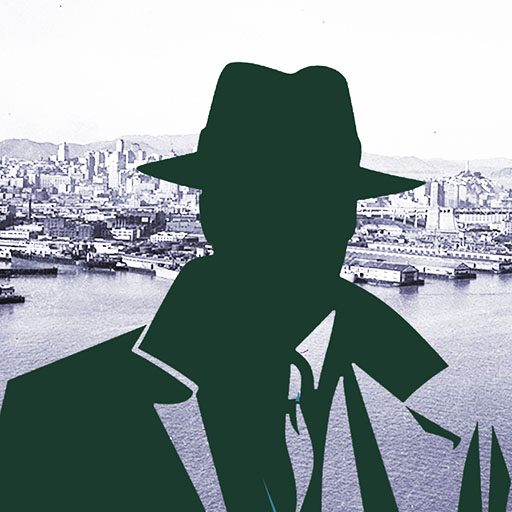
We are going to be covering in this podcast the post-war years of San Francisco, 1946 to 1953, mostly. I mean, there will be some background from years before that and years after, but that will be the main time frame that we’ll be looking at.
It will be focused on San Francisco, but there is a number of areas where there’s overlap with Hollywood and Southern California gangsters and stuff like that. Also, there was other crime activity in the outlying areas.
In the, in the San Francisco Bay area. So we, from time to time we’ll be, you know, over in Martinez, Emeryville down south.
So it was a boom time for San Francisco. The war was over. There was incredible nightlife, industry, business. It was thriving. And a lot of people had come here during the war and stayed when the war ended. Or when they came back home, they’d been here during the war on leave.
They came back after the war to our country. They moved to San Francisco because it was so cool. And it was the city the whole world was in love with. And there was a lot going on behind the scenes. A newspaper man named Bill Wren ran the town and the state Democratic Party. He worked for the Examiner, and therefore William Randolph Hearst.
On the other side was Bones Remmer, a gambler who had previously run the Cal-Neva Lodge up in North Shore in Lake Tahoe and came to town and kind of took over everything. They didn’t like each other, so that’s kind of what we’re going to be talking about.
As far as Patreon goes, all the main episodes of this podcast will always be free. If you want to be a supporter, subscriber, contribute, whatever you want to call it, there’s a $2 tier, a $7 tier, and a $12 tier for now. If you do $2, you’ll get the bonus episodes that we’ll be doing regularly. $7 will include e-books you can download that I’ll be producing with some frequency. As an introductory offer, I’m giving everybody a sample e-book, a booklet called The Secrets of Pisco Punch. And that was the legendary drink from the bank exchange, which was a bar in the financial district from the gold rush days until Prohibition. And so you can kind of see what kind of booklets are going to be coming. So they’re pretty cool.
Naturally, if you subscribe at the $12 level, I’ll send you a printed copy of the booklet. Whether you subscribe or not, I hope you will go to either the website, which is TheSecretHistoryOfFrisco.com, or the Patreon page, and download the free e-book, because it’s really cool, and you can learn all about Pisco Punch.
The last thing I want to tell is the story of how I discovered this era. I was a… I’ll tell as quickly as I can. I didn’t plan on talking this long. Back in the 70s, I was a copy boy or editorial assistant, wire attendant at the San Francisco Examiner. On Sunday evenings, I would go over to the bar at the Pickwick Hotel, which was kitty corner from the… paper and I’d have a sandwich or something and a couple of beers at the bar. It was very quiet there, unlike the M&M, which was always noisy. I wanted some peace so I could read.
And there was an old guy working there, and he finally asked me what I, you know, where I worked or something. And I said, over at the paper, and he asked me to go look for a picture that was taken outside his bar at Pine and Jones called Cooper and Varney’s in about 1950 or thereabouts of the board of supervisors standing outside his bar with their hands cupped around their ears to see if they could hear music coming out of the place because they were always trying to shut him down and I knew nothing about this at the time of course but I was soon to find out, so I went down into the examiner library where they kept all the old clips and the photographs and stuff, and I looked for Cooper and Varney’s, and what I found was an envelope with a bunch of phone taps from 1950 where Shell, I didn’t know his name yet, Shell was being phone tapped with talking to Bones Remmer, who’s one of the main characters of the pod. Well, they both are. And I was blown away. I mean, I had no idea, and I looked through all these things.
Unfortunately, I don’t have those phone taps anymore. I would love to find them. But anyway, so I reported back that I couldn’t find the picture. I don’t think it was an Examiner picture. I think it was a Chronicle picture probably. But anyway, you know, he started telling me about all that whole era. And it was just fascinating. And… you know, got kind of obsessed about it. And I started talking to other guys who were still alive that had been around back then and, you know, heard a few things that, you know, I will share. But finally, one evening, he said to me, what’s your name, kid?
And I said, Knox.
And he said, Knox what?
And I said, Knox Bronson.
And he stopped and he looked at me and said, are you any relation to Knox Bronson?
And I said, yeah, he was my grandfather.
And he stopped and put his hands on the bar and leaned into me, looked up and down the bar. There was no one else there. Looked right in my eyes and said, your grandfather was a player.
I feel a connection to that great era of San Francisco, the last years when it was a wide-open city. And that’s a story we’re going to tell. One last thing before I go. If you know of any history buffs that might like this podcast, please let them know about it.
And if you know anybody who has stories to tell from that era, whether things they’ve heard from their parents or grandparents, whatever, I’d love to hear from them. And if anybody has any ideas who can direct me in areas to research, do more research, or stories I should look into,
(I’d love to hear about that as well. Naturally, I’ve been to the Bancroft Library, San Francisco Public Library, all over the place, but I’m always looking for new leads and stories from that time. So thank you, and until next time, this is Knox saying, what should I say? I don’t even know.
What did they say back then on the radio? I’ll find out for next time.