
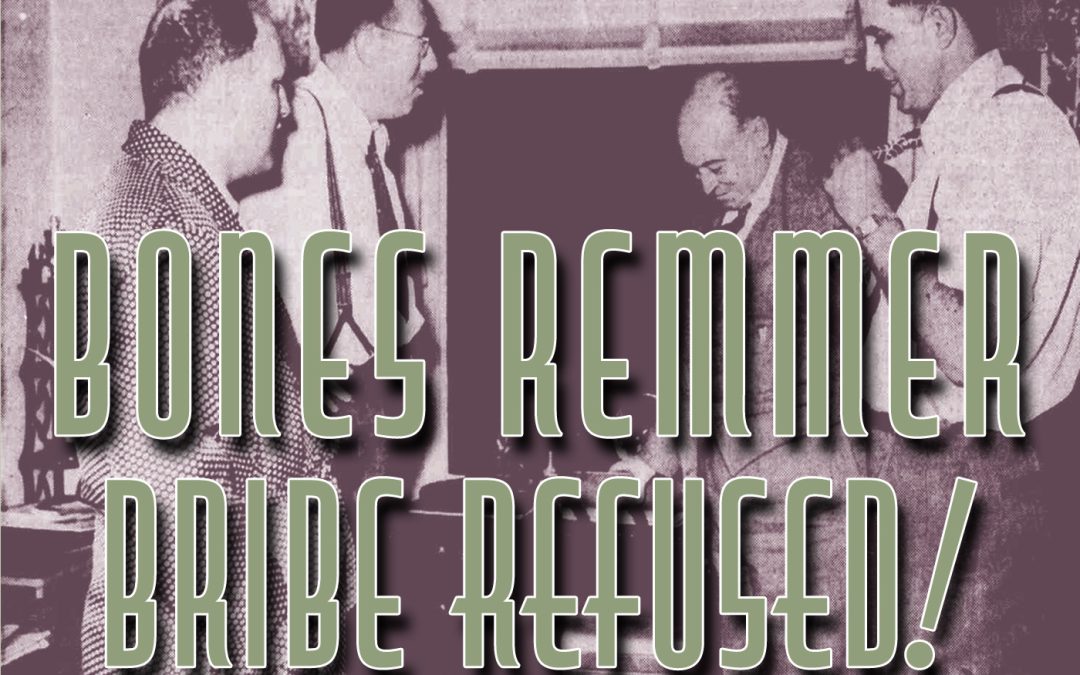
In this episode, I talk about the time well-known grifter, Charles Auberguy, he of the Frisco netherworld and serial inheritance scams, contacted San Francisco Examiner columnist Freddie Francisco, ex-con and brilliant chronicler of high society foibles and underworld gossip, with a lucrative bribe offer, $500 a month, for laying off Chin Lim Mow, aka The Chinaman, gambling boss of San Mateo County.
Freddie played along and invited Auberguy to come visit him at his luxury apartment atop Nob Hill, replete with butler, the following week.
Immediately, Examiner Editor Bill Wren, Freddie, reporters Ernie Lenn and Ed Montgomery decided to capture the whole thing on tape, and laid out the plan. A few hours before the appointed time, they wired Freddie’s plush digs for sound.
Auberguy showed up right on time and tossed some carefully folded bills on the table. Freddie maneuvered him over to the stereo where the microphone was hidden and drilled him for details about the who what when and the how much he was going to make each month. We have a transciption of that conversation in the episode..
When Freddie spoke the agreed upon phrase, the two reporters, the sound man and the photographer, burst out of the back room, flash bulbs popping.
Auberguy didn’t protest. He smiled sheepishly, picked up his cash, and walked out into the night.
There was a fair amount of fallout. A sledgehammer raid at The Chinaman’s 101 Club south of the city. Police blockades at Bone’s Club on Turk and Ed Sahati’s joint at the Hotel Somerton on Geary.
A lot of sound and fury, but nothing really changed in Frisco. That would take a few more years.
Come to think of it, that might have been the first payoff Freddie Francisco ever turned down.
TRANSCRIPT
Welcome to the Frisco: Secret History Podcast. I’m your host, Knox Bronson.
I have a great episode for you today. I just did a bonus episode on San Francisco Examiner Editor Editor Bill Wren and Bob Patterson, also known as Freddie Francisco, and the wager they made as to whether or not the word poontang would ever appear again in the pages of the paper after Freddie used it in his column.
I have shared a fair amount about the rascal Freddie Francisco, daily columnist and revealer of high-society shenanigans and alter ego of Bob Patterson, in the past.
In the last episode, I shared a thumbnail biography of Bill Wren, who, as editor of the Examiner, dominated San Francisco politics. He ran the state Democratic Party machine as well, with the weight of the Hearst Empire behind him. Freddie was Bill’s knight errant, even if they disagreed about the appropriateness of the use of the word Poontang in a family newspaper.
I’ve also told you a lot about Bones Remmer, gambling kingpin of the Tenderloin and points south and east. There is, of course, more to tell.
Bill Wren did not like Bones Remmer. Bones did not like Bill. In my last episode, I briefly mentioned Bill’s love of horses and of playing the ponies.
One of the first stories I ever heard about their mutual animosity so many years ago was that Bill would place a bet on a certain horse at one of Bones’ bookie joints and if that horse lost, instead of paying up, he would have the police raid the joint. Bill had that kind of juice.
Bill also had Freddie Francisco, the wicked wordsmith and Bones had his own knight errant, one Jimmie Tarantino, former Frank Sinatra hanger-on, and publisher of the tattle sheet and extortion rag, Hollywood Nite Life. Frank Sinatra and gangster Mickey Cohen had invested in the magazine its inception. I shared this story in episode five about Jimmie.
Bones wanted Jimmie to dig up dirt on Bill and Freddie. Bill wanted Freddie to dig up dirt on Bones and Jimmie.
This was a battle that went on for years.
In fact, the stories I heard from old guys who had actually been there was genesis of my interest in this seriously under-reported era of San Francisco history, the post-war era of Frisco. As I began researching those last years of the Wild West, I realized that I must cover the post-prohibition Thirties in San Francisco as well
This is the thing: the only reason I have yet to discover for the animosity between the two was Bill Wren’s method of avoiding paying his gambling debts. One guy told me once that Bill and Bones were fighting for control of gambling down the peninsula, but I have not yet found anything to corroborate that.
In my preview episode, I mentioned Shell Cooper, owner of Cooper and Varni’s saloon at Pine and Jones back in the forties and fifties, who was an associate of Bones and who also knew my grandfather, Knox Bronson, in my preview episode of this podcast. Back in the Seventies, when I made Shell’s acquaintance at a bar in the Pickwick Hotel at Fifth and Mission, Shell told me a few stories about the old days. I kept pushing for more, as I was fascinated, but Shell clammed up.
He said, “Forget about it. The ballgame’s over. People would get hurt, but I’ll tell you one thing: they were just as dirty as we were.” And then he repeated it, “They were just as dirty as we were.”
I can see and hear him saying it from behind the bar, clearly, fifty years later.
I still don’t know what he meant by that. I’m trying to find out.
Today’s episode is about Freddie and Bones and someone new to Frisco: The Secret History, private detective Eugene Auberguy, with an appearance of gambling overlord Chin Lim Mow, a.k.a. The Chinaman.
[intermezzo]
April 23, 1948
Headlines of the day:
Arabs Evacuate Haifa, Captured By Jewish Blitz
Red Flareup Smashed— Attempt in Italy Dies Aborning
Water at Shasta Dam Nears Flood Level; New Storm Here Possible Over Weekend
Gain in Slot Machines 52 Percent Increase In North California
GAMING STARTS IN SAN MATEO
The biggest headline of the day was:
Private Investigator Offers Bribe for Examiner Writer to Lay Off Gambler Bones Remmer
And that’s the spoiler for this episode.
The big song of the moment was Mañana is soon enough for me by Peggy Lee.
[excerpt]
If a singer released that song today, it would end their career.
Top movies at the box office were:
Mr. Blandings Builds His Dream House: A classic comedy starring Cary Grant and Myrna Loy about the perils of home ownership, which saw wide release in late March and April.
Winter Meeting: Bette Davis’s first film in over a year.
The Big Clock: A definitive film noir starring Ray Milland and Charles Laughton.
Here’s Myrna instructing her contractor as to the colors she desires for her new home, who then makes sure his painting subcontractor understands.
[excerpt]
We’re going to have to do a little time-hopping in this episode. Don’t worry, we won’t jump more than a year one way or another.
First, we’ll skip back just one week to April 16, when semi-notorious local private eye Eugene Auberguy approached the inestimable Freddie Francisco with a proposal.
Auberguy, to whom Freddie himself had described as the brainy, brawny, belligerent Basque in his column just a year before, was a somewhat seedy operator in the Frisco netherworld of grift and scams. He had underworld connections and a taste for the green. His name had appeared in the papers many times since the 1920s. He was mostly known for being an heir hunter.
In fact, Freddie’s piece detailed Auberguy’s research and financing of a woman’s claim on the vast Flood family fortune, of the San Francisco Floods, whose mother had had an affair with James Flood Jr. Together they sued the estate after his passing and won $1,200,000, split between the woman and Auberguy, and the lawyers, of course, but that is a story for another day. Not all of Auberguy’s lost heir claims were that legitimate.
Auberguy was a friend to Bones Remmer and Bones wanted to get a message, a proposal, if you will, to Freddie. So he enlisted Auberguy to be the go-between.
So on that Friday, April 16, Auberguy tracked Freddie down at some nightclub. Freddie was always out at the listening posts, nightclubs, saloons, restaurants, maybe Sally Stanford’s place, gathering stories and gossip for his column. Sometimes he was gathering the green to keep news out of his column. In any case, he wasn’t hard to find.
Auberguy approached Freddie and told him he had an offer direct from Bones Remmer, one that was worth a lot money to him. Steady money every month, simply for laying off Bones and The Chinaman south of Frisco.
Freddie told him he was definitely interested but had to leave right then and why didn’t Auberguy come over to his apartment at the Francesca Building the following Friday? The Francesca was a gorgeous luxury apartment building at atop Nob Hill, just a block from the Fairmount Hotel, the Top of the Mark, the Huntington Hotel, rarified air indeed. The apartments have been converted into condos in recent years.
A year into the future, Jimmie Tarantino, at Bones Remmer’s behest, would pose the question in his tattle sheet Hollywood Nite-Life, “Do the San Francisco police realize that this man, who never tried to “walk the straight and narrow” lives in a luxurious apartment at 850 Powell St., Apt. 409, employing a Negro butler? Not bad for a columnist who earns not more than $150 per week.”
Again, a story for another day.
I would ask the question, “Did Bill Wren, Ed Montgomery, and Ernie Lenn, ever question how Freddie could afford such impressive digs on a newspaperman’s salary? I suspect they simply turned a blind eye.
The Francesca building was designed by architects Gustave Albert Lansburgh and Kenneth MacDonald Jr..
Lansburgh had designed some of the most opulent theaters on the west coast between 1900 and 1930, including the Warfield, the Golden Gate Theatre, the New Orpheum, and the War Memorial Opera House. MacDonald designed some of the most impressive residential buildings in San Francisco, including Houses 3, 4 and 5 at Presidio Terrace, and his most spectacular work, the Spreckels Mansion.
After Auberguy took the bait, Freddie got ahold of Bill Wren to inform him of Remmer’s impending offer. With two intrepid crime reporters, Ed Montgomery and Ernie Lenn, they hatched a plot the next day.
Here’s how Ed and Ernie told the story:
[typewriter]
The springing of the trap came after an elaborate setting of the stage. Auberguy first broached the bribe offer last Friday night. Patterson stalled for time while the wire recording and witness arrangements were perfected. Auberguy again made contact with Patterson yesterday, and a meeting was arranged for Patterson’s home. Hours before Auberguy appeared, The Examiner retained Ignatius McCarthy, private investigator and sound man.
McCarthy placed a concealed microphone in a phonograph in Patterson’s front room, hooking it up to a recording device in a rear bedroom.
There, McCarthy, the two Examiner reporters, and an Examiner cameraman, holed up, waiting for Auberguy to appear.
The unsuspecting Auberguy appeared, and Patterson escorted him to the “wired” room, maneuvering him along side the phonograph. With earphones, the concealed reporters listened in on the conversation. Simultaneously, the conversation was being transcribed on the recording device.
By prearrangement with Patterson, they were to burst in after Patterson had pumped Auberguy, getting the bribe deals into the records. The signal for them to enter was when Patterson rejected the bribe. When the reporters heard Patterson’s rejection, on signal, they burst into the room, taking Auberguy completely by surprise.
Auberguy is sometimes called “the belligerent Basque.” His career has been sprinkled with incidents wherein Auberguy inevitably wound up on the side that won the money. More than twenty years ago his proclivities as an heir hunter came to the attention of the authorities when an action accusing him of conspiracy was filed in federal court.
As the result of the complaint, Auberguy withdrew from a case involving an heir to a large estate then under probate.
In the Flood litigation, Mrs. Gavin received just under a million dollars, This she split with her attorneys and in the settlement Auberguy got approximately $200,000.
For months, the talk has been that Remmer was linked with San Mateo County gambling operations. He denied this, but the talk persisted.
The State Attorney General’s office questioned Remmer last July, following racketeer “Bugsy” Siegel’s murder in southern California. Remmer emerged from the questioning announcing he was “as clean as a bundle back from the laundry.’” Remmer’s name popped up at a recent State public utilities commission racing wire-bookie hearing here. It was revealed that he had racing a news telegraph ticker in his office here last year.
It was further revealed that another ticker tape had been placed in a cottage next to the Wagon Wheel, an El Cerrito gambling establishment, in which Remmer had an interest.
[end typewriter]
Bones had gambling interests down the Peninsula. His partner was Chin Lim Mow, reputedly the Bay Area’s most powerful gambling operator of Chinese descent. His turf was San Mateo County and, while he had not ever been arrested on gambling charges, he was constantly in trouble with the IRS and the State Franchise Tax board going back at least two decades. He had done a year in prison for payroll discrepancies.
Under sixteen aliases, Chin had been the owner of eight “gaming” clubs at Bayshore City, ten bank accounts, seventeen brokerage accounts and various properties in downtown San Francisco and Oakland.
Bayshore City was a tiny area about thirty blocks square with eight hundred residents just west of the Cow Palace and south of San Francisco. It was incorporated as a city in 1932 to create an area where greyhound racing would be legal. When greyhound racing was outlawed in California in 1939, the city was disincorporated in 1940 and was annexed to Daly City in 1963.
Nonetheless, there was plenty of gambling going on in San Mateo County. Chin Lim Mow was Bones’ partner there.
[intermezzo]
The appointed day came. Eugene Auberguy arrived the Francesca apartment building, identified himself to the doorman. The doorman let him in. He took the elevator up to the fourth floor, where Freddie lived in a luxuriously appointed apartment. His butler opened the door and welcomed him.
Auberguy entered the room where Freddie was standing. He greeted Freddie and threw the a wad of neatly folded bills on a table and said, “Here’s your first payment.”
Freddie said: “I want to find out exactly what it’s for, What do you want? How much a month?
A.-500.
P.-I’m simply not to write about any gambling down the peninsula?
A.-No, no,-just the Chinamen.
P.-Just this one place, the Chinamen?
A.-That’s all.
P.-Does McGrath know about this?
A.-Not a word.
P.-Remmer knows I’m getting this?
A.-Yes.
P.-He’s not going to enter the picture at all? . . . It’s going to be strictly through you?
A.-You and me no one else.
P.-How about McGrath?
A.-He knows nothing about anything Jim’s a busi nessman, I’m a businessman-nothing, not the slightest idea.
P.-How much does Remmer think I’m getting? Does he know I’m getting $500?
A.-That’s right.
P.-And that is only not to write about him.
A.-Not to roust him too much.
P.–But to roust him a little bit?
A -Well, if we get to the point where he should be rousted then you and I talk about it, that’s all.
P.-I want to know exactly what the $500 a month is for. It’s $500 a month isn’t it?
A.-That’s right. You’re getting $500 in two payments. $250 bimonthly and through me and don’t worry .. and you’re not to roust him too much, except when we get together and cut up a touch.
P.-How about McGrath?
A.-Never heard of it . .. never heard of it … and will never hear of it. No one will ever hear of it.
P.-But he knows about the 101 operation?
A.-I know nothing about that know nothing. So hence he can’t know nothing and know Jim pretty well you know I made that county down there years ago.
P.-I didn’t know that you mean you made the operation down. …
A.-No, no, not the operation ..the county. …
P.-You mean politically.
A.-That’s right and don’t forget how do you think $5,000 on the whole-county. but be that as it may, Jim knows nothing. I haven’t seen Jim. …
P. Remmer knows you contacted me today?
A.-Not today.
P. He knows you’re paying me this money, for protection of the operation.
A. Goes through him goes through Bones .
P.-It goes through Bones to you to me.
A.-That’s right
P.–Is that the deal?
A.-That’s right.
At this point, Freddie announced he wanted no part of the money, and his fellow reporters, a photographer, and the sound man burst into the living room.
Faced by the reporters and the popping flash bulbs, a sheepish expression crept over Auberguy’s face. Momentarily, he hung his head, He then offered a smile to all and shook hands with Freddie.
He picked up the folded bills off the table and said, “At least this much is saved.”
He pocketed the bills, turned around, and abruptly exited the premises to parts unknown, probably down to the Menlo Club, where Jack Ruby had once dealt cards, to warn Bones of what was coming.
Trying to bribe a newspaper reporter is not illegal, but the headlines they generate are like shooting the metaphorical dart into the metaphorical beehive.
A couple hours after Auberguy strolled out of Freddie’s apartment, San Mateo County Sheriff Jim McGrath’s Chief Deputy Walter Moore and Deputy Sheriff Milton Minahan went Chin Lim Mow’s 101 Club just over the county line, but could not gain entrance.
Moore took a sledgehammer on the door, and finally the door was opened, to reveal a number of Chinese lolling about but no gambling. This followed the usual San Mateo County gambling “raid” pattern.
Someone had tipped them off.
I wonder who.
The next day, San Francisco police blockaded Bones’ Menlo Club and another owned by Eddie Sahati, a Nevada based gambler who had opened a gambling club in the Hotel Somerton at 440 Geary St.
The Examiner reported:
Police blockades were thrown around the incorporated, ostensibly legal “card” clubs operated here by Remmer and Sahati. Remmer’s is the Menlo Club, 30 Turk Street. Sahati’s is in the Hotel Somerton, 440 Geary Street.
“Intermittent raids also will be made at both establishments, said Police Chief Michael Mitchell.
“Remmer, Sahati and others of their ilk will be kept under pressure and surveillance, “until they realize things are too hot for them here,’ Mitchell warned.
Mitchell ordered that any one without a membership card in the two incorporated “card” clubs be arrested and police will check on whether or not legal games are being played. –
Mitchell said he had reason to believe that Sahati, who also operates the State Line Club at Tahoe, would be out of San Francisco by the first of the month. Sahati is scheduled to go to Tahoe to prepare for the summer gambling harvest. But the police made it clear his return next fall will not be welcome.
Remmer, Sahati, and Auberguy were ordered picked up for questioning in connection with the bribe offer, Mitchell announced.
Auberguy’s private detective license was in jeopardy, San Francisco District Attorney Brown revealed.
San Mateo County Sheriff James J. McGrath denied any relations with either Auberguy or Remmer in the bribe expose.
Chief Mitchell, outlining his campaign against Remmer and Sahati, said: “We are out to mummify so-called visiting out of State characters. They will not be tolerated in San Francisco.”
“Officers will be stationed outside the doors of both their incorporated clubs, day and night. All patrons entering will be subjected to intensive questioning. The customers there won’t like that.
“Then there will be periodic raids, inside the two clubs. The customers won’t like that, either. “In every raid, the officers will first look for any law violation. Then, each customer inside will be asked to show his membership card in the club, where only legal games can be played.
The only legal games are draw poker and pangini.
“If a customer fails to have a membership card, or his name is not in the club’s register, that customer will be arrested.
At Remmer’s Menlo Club, even regular members who weren’t carrying their membership cards were turned away. This included a janitor at the club.
At Sahati’s Geary Street cardroom and Remmer’s, police were taking the names and addresses of every person entering the establishments.
[end typewriter]
Do you remember in Frisco episode number two, “The Hawaiian Princess Who Wanted To Sing” when Central Station Captain Fred Lemon stationed a permanent detail of six uniformed officers at the Kamokila Club’s doorway on Bush Street to discourage customers back in 1936? All because she refused to make the proper payoffs to the McDonough Brothers and the police? Things were different in Frisco back then.
[typewriter}
Meanwhile, District Attorney Brown conferred at length with two of his deputies, Thomas Lynch and Norman Elkington. They discussed the bribe offer and the presence of Nevada gambling characters here.
Brown said he will co-operate fully with the police in the cleanup campaign. He and his deputies pored through the State penal code, seeking some measure by which the bribe case could be prosecuted criminally.
“Unfortunately,” explained Brown, “we discovered there could be criminal prosecution only if a bribe is offered to a public official, or in a sports case involving baseball and the like.”
However, Brown’s office cited the State business and professional code, in connection with Auberguy’s private detective license. The State department of corrections, which has jurisdiction over private detective licenses, can revoke or suspend such a license for any cause which the department deems sufficient.
[end typewriter]
I haven’t mentioned it before, but District Attorney Brown, Edmund G. Brown, the future Governor of California, was the lawyer Bones hired in the early Forties to write the incorporation papers for his Menlo Club. Years later, shutting down Bones and all the other houses of adult recreation became his raison d’etre. He was a politician first and foremost. Frisco had changed dramatically after the war, even driving Sally Stanford out in 1948, when she moved to Sausalito.
[typewriter]
Remmer, whom Chief Mitchell ordered to be picked up for questioning in connection with the bribe offer, was unavailable yesterday. “My men, who went out looking for him, have information that he may be hiding out,” said Mitchell. “They were told that Auberguy was around looking for him around 7:30 a. m., after The Examiner bribe story hit the streets.”
Auberguy, who is also a store executive in Oakland, was contacted by phone there later in the day by police. He said he would appear voluntarily at Brown’s office for questioning. In an interview with an ExamIner reporter in his Oakland store office, Auberguy declined to discuss the bribe offer. “It’s all over and in the past,” he said. “I have no hard feelings against any of the boys (the reporters who participated in the trap), or the paper. You’ve got a job to do I’ve got a job to do.
“I’ve worked with the newspaper boys a long time. I know a lot of them.”
[end typewriter]
[intermezzo]
So the heat was on in this Frisco springtime of 1948. San Francisco was booming: shipping, printing, manufacturing, nightlife, culture. Soldiers and Navy men who had passed through Frisco during the war were returning to beautiful city on seven hills, bring their backwater midwestern morals with them.
For now, nothing would change.
Freddie Francisco never mentioned his little joke on Eugene Auberguy and Bones Remmer again, but a few days later he would write:
[typewriter]
The headline read, “Tenderloin in Tizzie Over What’s Next?”
“WHAT NEXT?” This is the question that is being asked in various ways throughout the Tenderloin. The sharpies and the schmos, the guys and the dolls, the characters with the plaidcoat-and-tieless-sport-shirt ensembles that have almost become the uniform of the district, are all asking, “What next ?”
Weekend police activity in the Tenderloin-especially in the card rooms and in the Remmer realm (the Turk-Mason salient) has created an epidemic of jitters in the community equaled only by the reaction, last year, to the purges that followed the De John killing.
According to the grapevine, the upper-bracket gambling personalities are all out of town. The others are of no particular interest to any one, so further official action seems stalemated for the present. Everywhere you go in the Tenderloin you hear the question: “What’s next’
[intermezzo]
[full outro]
Frisco—the Secret History is a listener supported podcast. Main episodes will always be free. Our website is www.friscothesecrethisory.com. Visit the website for show notes. Paid tier members, starting at as little as $5 a month, will receive bonus episodes and other perks of membership. There is a one dollar tier, but that will simply give you ad-free episodes when I get some advertisers.
If you enjoy the podcast, please tell your friends about it, especially those who enjoy San Francisco or true crime history. Word of mouth is the absolute best means of promotion for any creative endeavor in this world of algorithms and the ceaseless barrage of ads, notifications, and appeals on every digital platform. If you are aware of some particular aspect of San Francisco history in the thirties and forties you would like me to research, or have a story to tell, please let me know.
Once again, I’m your host, Knox Bronson.
Thank you for listening. Until next time, please get a little crazy and call it Frisco.