
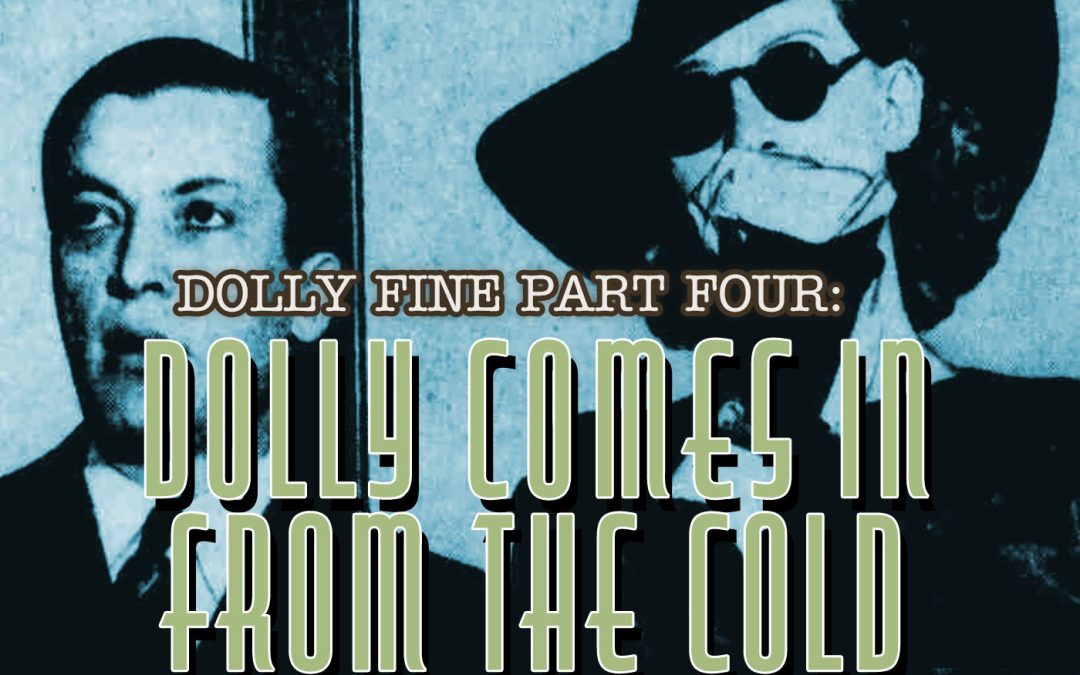
In Part Four of the Dolly Fine story, I bring the Dolly Fine story to a close.
Where we last left off, Dolly had been arrested and charged on eight felony counts of contributing to the delinquency of a minor. The DA had her dead to rights and such was the political climate of the moment, he was going to make hay by pressing her to the full extent of the law.
Instead of arriving for her arraignment, she took flight and forfeited her $1000 bail. Every sighting of her, from San Diego to Paris, made headlines around the country. Dolly sold papers.
On the eighty-ninth day of her exile, she got word to her attorney, Jake “The Master” Ehrlich, to arrange for her to turn herself in. Jake met Dolly in Oakland, covered her face with a large scarf and sunglasses and they took the ferry back to Oakland.
On the morning of her trial, Jake pulled one of his most Ehrlichian moves and brought Frisco’s elites face to face with their own hypocrisy.
Did Dolly walk?
Of course she did, but at what cost?
Because Jake had demanded quite an unforeseen fee for his services.
Welcome to the Frisco: the Secret History Podcast. I’m your host, Knox Bronson. I have a wonderful episode for you today: Part Four of the Dolly Fine story, one of Frisco’s last great madams.
In Parts 1 through 3, I recounted Dolly’s rise to prominence in San Francisco’s underworld, beginning as a gangland moll, lookout, and bootlegger’s apprentice in her teens, and on to running the most profitable bordello in San Francisco by the late 1930s at 1275 Bush Street.
Although she had always made the proper payoffs, certain reformers and politicians and a number of cops, along with the District Attorney, had their eyes on Dolly and all the other brothels in town, and there were plenty of them.
San Francisco boasted a vibrant nightlife all throughout the Thirties. Speakeasies, bordellos, gambling joints, after-hours clubs abounded in the early years of the decade. Prohibition had barely impacted the city. After the Volstead Act was repealed in 1934, everybody just started operating out in the open again.
Dolly had been called to testify before the Grand Jury after the release of the Atherton Report in the Spring of 1937. I covered this story in Part One of the Dolly Fine story in great detail. The Atherton Report revealed an incredible amount of corruption with in the San Francisco Police Department, estimating that the department had pulled in $1,200,000 in payoffs in 1937 alone. That is over $30M today.
Frisco had a reputation as one of the most tolerant cities in the world for good reason.
As B. E. Lloyd wrote in Lights and Shades in San Francisco, 1876,
[typewriter]
“We do not wish to say, or even imply, that San Francisco is the wickedest and most immoral city in the world; that her men are all libertines and her women all fallen; that she has no noble sons and pure daughters. This is only a single chapter on her wickedest ways-the deepest shade among many brilliant lights.
[end typewriter]
But this was the Frisco the whole world loved. Gone was the Barbary Coast with its trapdoor Shanghai saloons and backdoor alleys where thieves, pimps, and murderers lurked. By the end of Prohibition in 1934, the city was considerably more civilized, but it was still an outlaw town, even as cultural norms were shifting.
In late, 1936, there was enough political pressure on the powers that be that the District Attorney hired one Edwin Atherton, a former G-man, now a private investigator based in Los Angeles—I guess they wanted someone they could be fairly certain was not connected to the existing Frisco graft machine—to produce a comprehensive report on corruption in the city. I have covered the roots of that pressure in prior episodes.
Atherton understood the assignment. He opened his report with the following:
[typewriter]
Instructions given to us at the beginning of this case were to investigate the allegations of graft in the San Francisco Police Department and to develop as much in the way of facts and evidence as possible on this subject. We were permitted to outline our own procedure so we determined upon a three-point program, as follows:
1 To ascertain whether there was a substantial foundation for the allegations against the department.
2 To purge the department of the maximum number of corrupt officers.
3 – To prosecute such officers wherever possible.
The first objective was, of course, a fundamental one, with action on the other two largely contingent thereon, so it had to be determined first. In this regard it might be pointed out that there was apparently no specific, dependable data available on the volume and extent of the alleged corruption or on the identities of the sources and beneficiaries of such corruption, if any. Therefore we had to start from “scratch” and develop these data ourselves as a predicate for any further action one way or the other.
In this connection it was our intention to recommend against continuance of the inquiry if it were found that there was only limited amount of graft and that only a few members of the department were corrupt. This was considered the practical position to take because of the realization that no police department in a large metropolitan center is, or probably can be made, entirely free of graft. Therefore we felt we would not be justified in carrying out an extensive investigation of a situation which did not present a serious problem.
As you know, the revelations produced by the first phase of the investigation reflected such a grave condition in the police department that we were not called upon to decide whether or not the undertaking should be continued. This question was answered by the public and press, which demanded vigorously that the investigation go on. In proceeding with objective No. 1 of our program, we naturally knew from experience that police graft has its origin in vice activities and other unlawful enterprises or “rackets.”
In other words, that persons engaged in violating the law must pay so-called “protection money” for the privilege of doing business. We therefore took a survey of these activities in order to ascertain the location, approximate number, volume of business and the identity of the operators.
This survey was not as exhaustive as it might have been and did not go into some activities as well as others, due to our comparatively small staff and the persistent pressure on us to produce indictments. However, it was sufficiently comprehensive to provide an illuminating background for the entire graft picture.
At this stage it should be pointed out that, when we were employed we were informed this investigation was not intended be a moral crusade in the sense that it should bring about the closing of unlawful businesses, as such a course was contrary to the desires of the great majority of San Franciscans. From previous residence in the city, we were aware that the bulk of the people wanted a so-called “open town” and that the history of San Francisco reflected a public attitude of broadmindedness, liberality and tolerance, comparable probably to only two other American cities, namely, New York and New Orleans.
[end typewriter]
The publication of the report in March of 1937 hit the city like an atomic bomb. It wasn’t the question of Frisco being an open town, which the majority of San Francisco’s citizens wanted, it was the vast amount of money being raked in by the McDonough Brothers and their hands on the levers of the city’s whole criminal justice system.
The McDonough brothers operated a shadow justice system in San Francisco for over thirty years. Peter and Thomas McDonough, famously dubbed the “Fountainhead of Corruption” by the 1937 Report, didn’t just influence the courts—they integrated them into their business model.
The brothers ran a bail-bond empire from their saloon at Kearny and Clay Streets, strategically located across from the old Hall of Justice. Their influence over judges was blatant and systematic.
Within minutes of an arrest, a McDonough representative would hail a taxi, locate a friendly judge (often at a restaurant or social club), and have them sign an “Own Recognizance” release form. This bypassed the standard legal process, allowing criminals to return to their various enterprises before the charges they would later face were even filed.
Frisco’s “Wide Open Town” policy was maintained by a political machine that relied on McDonough cash. They were frequently accused of tampering with judges, suborning witnesses, and bribery to ensure favorable outcomes.
But let’s face it, everybody was making money and having a great time.
As Sally Stanford put it in her memoir, A Lady In The House,
[typewriter]
They were a wonderful set of burglars, the people who were running San Francisco when I first came to town in 1923, wonderful because, if they were stealing, they were doing it with class and style. When they turned City Hall and the Hall of Justice into a pair of stores with bargains for all, they did it with charm, finesse, and what the French call “savoir-faire.”
They were the municipal swashbucklers and the civic high-binders. And compared with today’s local statesmen, they didn’t really try very hard to be much else, except just before election.
This is understandable. The politics of the town were dominated by Mayor Jimmy Rolph (Sunny Jim, or Dirty Jim, depending upon where you sat politically), but believe me, he was a doll, a political dreamboat. Say what you will for New York’s Jimmy Walker or Boston’s Jim Curley, Jimmy Rolph wore San Francisco like a tailor-made plaid suit and on him it looked wonderful. Not only did Jimmy do o.k., but the rest of us did pretty well too. For if there ever was a live-and-let-live type, it was Mayor Rolph of San Francisco. At one time in his colorful career, when asked to make a statement about prostitution he said, “Leave it alone; just regulate de a was s motto. Although the old Barbary Coast was gone, the town was spinning just as lustily as it always had ever since the first pirate stepped down the gangplank from his ship, looked around, and ordered a passing Indian to bring on the women.
Sally also said, “The reformers are just the guys who didn’t get invited to the party.”
And this: I’ve always said that if I ever told everything I know about the ‘pillars of society’ in this town, the columns would crumble from embarrassment.”
[end typewriter]
Remember that last remark when we come to the end of Dolly’s story.
The Atherton report named 24 government officials (including a number of judges and politicians) and 67 police officers as being part of the McDonough machine.
The report stated that it was understood within the FrISCO underworld that “no one can conduct a prostitution or gambling enterprise… without the approval direct or indirect of the McDonough brothers.”
Elsewhere, if a judge didn’t play ball, the brothers had the political muscle to make his or her reelection very difficult.
The Atherton Report stripped away the McDonough brothers’ veneer of legitimacy, leading to the revocation of their bail-bond license. Pete McDonough even spent time in jail for refusing to testify about his connections to the “Police Graft” grand jury. In those hearings, phone taps revealed discussions between the McDonoughs and the police about which night a certain brothel would be raided, how many girls would be arrested, and so on. Dolly was mentioned more than once.
[intermezzo]
The Atherton Report was a tipping point, although everybody tried to keep operating as before.
Clearly, change was in the air.
I related Dolly’s Grand Jury appearance in an earlier episode as well as the raid over a year later, where the cops burst in to Dolly’s house on Pine Street as the result of a tip-off from a society matron who overheard her son telling a friend that he and the gang were going to Sally Stanford’s after the school prom. Sally turned them away, but the maid at Dolly’s place let them in and the cops pounced. Now, Dolly was facing sixteen years in prison and sixteen thousand dollars in fines.
Forget that there were hundreds of other brothels in the city. This story of underage boys in Dolly’s house was a public relations dream for the DA, the police, and everybody else who wanted to show that something was being done about vice in Frisco.
They had Dolly dead to rights.
On April 29, 1938, Dolly was due to report for her arraignment in court.
But Dolly was in the wind.
Her flight made headlines across the nation.
After she took off, reporters kept digging into her past and present, as well as her possible whereabouts. She was reported to be in San Diego, Mexico, Hawaii, Alaska, where she was born, Chicago, Paris, France, at a bar just south of San Francisco, and every sighting made nationwide headlines.
On May second, Chicago Chief of Detectives John L. Sullivan sent San Francisco Police Chief Quinn:
DOLLY FINE ALIAS DOROTHY HARDING ARRIVED AT 2:40 P.M. APRIL 29TH USING NAME MRS. L. O’BRIEN TOOK CAB TO LAWRENCE HOTEL PAID DEPOSIT ONE DOLLAR UNDER NAME MARIE SORENSEN. ALSO PAID DEPOSIT ONE DOLLAR VICEROY HOTEL SAME NAME SAME DATE HAS NOT RETURNED EITHER HOTEL? WILL ADVISE IF APPREHENDED.
But Dolly was not in Chicago.
Of course, Dolly still sold newspapers. A reporter for the San Francisco Call Bulletin bribed the caretaker of Dolly’s house in Pacifica. He called it the house that sin built, with a doorbell that sounded like soft chimes. He described the red bar with gilded dragons and a grand mirror and the red window shades throughout the house.
In another story he wrote:
[typewriter]
Notes Dolly’s Home Reveal Life of Luxury
Numerous Receipts Disclose Evidence of Her Wealth
Confidential memoranda left behind by Dolly Fine in her hasty flight from the law today became “dated data” that furnished significant clues to her lucrative brothel enterprises. Papers, addresses, telephone numbers, receipts for brothel rentals all presented a graphic picture of the activities of the blonde “lady in red,” who is the object of an all states’ search as the chief figure in San Francisco’s latest vice furore.
As authorities extended the hunt to eastern air terminals, the possessions that Dolly left behind revealed a strange dual existence-the life of a feminine prototype of Dr. Jekyll and Mr. Hyde.
“How to Live on Twenty-four Hours a Day” was the demonstrative title of an Arnold Bennett book.
[end typewriter]
This was an early self-help book published in 1908.
[typewriter]
To Dolly Fine that meant: By night madame of brothel, assigning girls to patrons. By day chatelaine of a luxurious seaside home.
What price vice? To Dolly Fine, the profits of this oldest profession brought realization of all that a woman dreams of-rich raiment, fine cars, a beautiful home-all, that is, but one cardinal asset: self respect.
In her role as keeper of a bordello, Dolly, clad in a symbolic scarlet ensemble, directed the sordid activities of “profit sharing” prostitutes ruled over dimly lit, gaudily appointed rooms–played hostess to all sorts and conditions of men.
In her daytime role as mistress of a home, she lounged in costly negligee before a crackling fire, read typically lurid literature, listened to the ceaseless rumble of the surf nearby. Her Sharp Park home, reputedly a $16,000 structure, furnished in the best of decorative taste. In her boudoir, like that of some rich movie star, is a cozy fireplace. Everywhere are costly drapes, ultra modern furniture, And one ironic touch for the madame of a notorious house of prostitution–a big, lifelike, lonesome doll on a chaise lounge!
He listed some of the title of the romance novels he found on the bookshelf there:
Young Desire … Trapped By Love … The Reason Why … Marriage For One … Other Men’s Wives . . . Poor Little Fool. New Worlds to Conquer … The Veiled Lady … The One-Way Ride . . .
[intermezzo]
After Dolly was arrested and before she disappeared, she hired the best lawyer in the country, her friend Jake Ehrlich, who seemed to be at the center of every big Frisco criminal case for four decades.
I’ll let Jake tell the story:
[typewriter]
“What are they going to try to do to me?” was the first thing Dolly asked when I met her at the Cliff House at Pacific Ocean Beach immediately after my return. As a restaurant the famed Cliff House possesses only two merits, as far as I am concerned. It looks good on picture postcards and it draws the tourist hordes away from the more desirable eating places. Few San Franciscans ever go there. I had chosen it in the hope of minimizing the chance that my striking client would be recognized.
I replied to her tremulous question with the only honest answer 1 could give. “They’re going to try to stone you to death as their fellow knuckleheads did your predecessors in Old Testament days. Or something pretty similar, Dolly.
She digested this for a moment and was suddenly no longer tremulous. When the chips were down, Dolly could come up with courage enough. Her next question was asked in a firm, poised, almost objective voice.
“Are they going to get away with it, Jake?”
“Hell, no!”
“What makes you think not? There’s so many of them … the cops and judges and the Christers and the newspapers and the lily whites … and God only knows what all … and in this corner, fighting at one hundred and ten pounds, only me.”
“And me, Dolly; J. W. Ehrlich, Barrister at Law.” I winked at her, and her somber mouth line curved into a smile. “You want to know why they can’t get away with it? I’ll tell you.
Because they’re fools, led by fools, frightened by fools, instructed by fools. Blind bigotry has no brain, girl; intolerance has no courage.” I thought again of the supercharged headlines in the morning papers and of the fearful and hysterical promises of vengeance from the district attorney, and I felt a momentary tendency to regurgitate.
“If this were merely a routine prosecution of a routine offense, Dolly, I’d be giving you a routine defense and my personal feelings would not be involved. But it’s quite something else. So I’m going to pull out all the stops. Before I’m finished the people of this town may learn a little more about the various kinds of sin. One thing is sure; they’ll be able to tell the players apart without a program.”
And suddenly we were laughing, the moment of doubt and hysteria was past, and Dolly was herself again.
“How much will it cost me to be saved from being stoned to death?”
“A lot, probably. However, part of my fee won’t be paid in cash, Dolly.”
She smiled her rather sweet and unmadamly smile.
“Don’t tell me you plan to take it out in trade, Jake?”
“Not me, Miss Fine. I’m a man who believes that the best things in life are free, or should be. What I have in mind is a solemn promise which you’ll honor the way you honor your other just debts …
“And the promise…?”
. is that if I snatch you away from the lynching party Matt Brady and the vigilantes are lining up, you’ll get the hell out of prostitution and stay out of it forever.” She looked me in the eyes very carefully, as if to seek out the gimmick—it gimmick there was-and then asked a question.
“Why?”
“Because I can’t stand waste. If you were a blowsy slattern, I’d take a fee for your defense and let you return to whatever level of life you chose. But you’re too intelligent and attractive a woman to be committing suicide on the installment plan in this fashion. Suicide is utter waste. I hate waste.” She nodded in understanding and we shook hands on our bargain.
“Now that I’ve talked myself out of a lifetime of fees,” I said, uncomfortable in the new seriousness of the moment,”let’s get down to business. Tell me the whole story. Everything!”
After I had all the details, it became baldly clear that keeping my promise would be an uphill hike. I dropped in on the district attorney, Matthew Brady, to find out whether his official bite was as bad as his press-reported bark, and discovered him in a moment of righteous rage. Neither extremes of diplomacy nor ironical references to his own past intimacies with the matters that now outraged him were helpful in bringing him back to earth.
The newspapers continued to harangue their readers with incendiary copy of a nature to convince every mother in town that her moppet son might be giving up marble playing in favor of more robust pleasures, and that leering streetwalkers thronged the grade school playgrounds. Police Chief Quinn quickly got into the act with a stalwart statement to the effect that his officers had found it impossible to close Dolly Fine despite a record of thirty raids on her brothel. In the terminal raid he said that, “the police struck to protect the morals of boys of high school age,” but didn’t specify what prompted them to strike on the other twenty-nine occasions.
The police department immediately ordered a “blockade by officers” of ten other “known bordellos,” something of an irony in law enforcement and one which suggested the extension of this gentle policy to the picketing of burglars as they burgled or the issuance of traffic citations to holdup getaway cars.
One of the afternoon papers purchased the serialized memoirs of “A Girl of the Tenderloin” on the assumption that its readers might care to come to more intimate grips with the subject on everyone’s minds and tongues at the moment.
Three male members of the Grand Jury approached the district attorney and then the chief of police and finally the San Francisco Examiner with a truly selfless offer to undertake, “an undercover field investigation” of the town’s bordellos, if subsidized. The offer was regretfully declined.
[end typewriter]
And then Dolly disappeared. No one knows if she and Jake remained in contact during her days in the wilderness. Neither ever admitted it, in any case. Jake’s phone had been bugged during the Atherton investigation and there was no telling if it been removed.
Jake understood that Dolly was buying time. He didn’t believe she would stay on the lam forever.
There was a provision in the law, that allowed for a ninety day grace period on forfeiting bail. Near the end of that period, he got in touch with Dolly’s brother and told him to pass on a message.
He wrote:
[typewriter]
According to a little-known statute, a bail bond may still be regained and the bailee exonerated under certain conditions provided that he or she puts in an appearance in less than ninety days. It was now one day less than the specified ninety days, and the heat of the press and the righteous rancor of officialdom had diminished considerably. I explained all of this to Larry Brady, Dolly’s brother, and told him to re explain it to his sister and then produce her at once.
Within an hour I was contacted with the when and where of my client’s surrender. The how I’d pretty well worked out by myself. And because I believe that even a stubborn, self-serving district attorney is always entitled to one final chance to cleanse himself of an ill-advised commitment, I paid one more visit to Mr. Brady. Would he consider rational degree of leniency for his victim if she were to become available for due process?
“Jake,” he said, “go peddle your papers! I’m going to give that woman the works. The full works. And you, too, if you try any of your tricks.
I smiled into his big, red, hostile Hibernian face and felt like David casing Goliath’s forehead for the precise point at which to loose the shot. For I had the shot and had carefully laid it away for this occasion before dropping off to sleep that night three months before in the hotel room in Los Angeles.
“Thank you, Matt!” I said. “You’ve made it easy for me.” Then I walked down to O’Connor Moffat’s (a fine Irish-Catholic-owned store where I often traded) and bought a long, wine-colored veil and a pair of dark glasses.
At three o’clock of the next afternoon I took the ferry-boat across the bay to Oakland. Close to the center of this sleepy but wholesome little city is a beautiful stretch of water known as Lake Merritt, named in honor of a man whom not one Oaklander in ten thousand can identify.
Children wade there, sailors rent dories and swans hiss at both. Here also waited Dolly.
“Hello, Master!” she said. “What do you know?”
“I know that nothing is more pitiful in life than a prostitute who has risen from the streets, tasted luxury and …”
She giggled.
“Stop, for Pete’s sake! I got carried away. And the son of a bitch had such a nice sympathetic manner and hair on the back of his hands. I’ve always been a sucker for a man with hair on the back of his hands.”
“I’ll raise some. Now let’s get back to town and face the music. The tune is likely to be ‘There’ll Be A Hot Town In The Old Town Tonight, with Matt Brady giving the downbeat with a blackjack, but we’ll see if we can’t provide him with some new lyrics. Let’s go, Lady in Red!” She smiled her cool, relaxed smile. A woman can become very relaxed in ninety days of early to bed and no customers (or policemen) at the front door.
“I’m not worried, Jake. I’m with you.”
I’d be kidding myself if I pretended that the thrill of possessing the complete trust and confidence of a client ever really diminishes an iota. It’s the same for me now as it was on that faraway day when I first stood before the bar of justice, shoulder to shoulder with a sad little mixed-up miscreant who believed that I would win his freedom merely because I said I would. And I did.
I put the dark glasses over Dolly’s violet eyes and swathed her in the veil. She looked like the star of La Dame Aux Camélias and loved it. We headed for San Francisco.
The surrender at the Hall of Justice was a legal and journalistic tour de force, being timed to fall neatly within the time allowed for bail redemption and the hour before the deadlines of the first editions of both morning papers. Pandemonium broke loose in the second-floor pressroom, and there was considerable scurrying in the district attorney’s office as well, but I had more or less cleared the tracks in the essential places and Dolly was rebailed (at double the previous bond) and released to freedom before anyone could think of any really important official questions to ask her.
[end typewriter]
On September seventh, Dolly, accompanied by Jake, faced a jury in court for the misdemeanor charges made from the raid on her house. They found her guilty. She was fined $300 and a suspended sentence of six months, based on good behavior. She pulled a hundred-dollar bill, two fifties, and five twenties out of her wallet to pay her fine.
Now, this is where I want you to remember Sally Stanford’s remarks about the pillars of society.
Jake goes on:
[typewriter]
We were scheduled to go to bat in Superior Court on the eight felony charges on October 6th.
I arose even earlier than usual that day and at six o’clock I assembled in my office as tough, talented and undismayable a crew of process servers as money could buy. Their subpoenas, calling for five individual presences in court that morning at ten, were given them with instructions to serve the parties named within minutes of the hour of seven. I wanted to make sure that none of my witnesses had any opportunity to warn any of the others and thus inspire any evasion of service. Then I ordered coffee and sat by the telephone to await Mr. Brady’s call. It came at five minutes after seven, a truly impressive tribute to the punctuality of the process servers.
Brady was unhappy. Unhappy but somewhat more respectful and courteous than I’d found him of late. It appears that he had been awakened by a number of “our best people”— parents of some of the boys who’d visited the Maison Fine.
They had been subpoenaed to court, it seemed, and… “well, these just aren’t the kind of people you haul into court over sordid messes of this kind. The photographers and reporters and all … you understand, Jake! Now if there could be a meeting in Judge Isadore Golden’s chambers a little before court, we might come to a …”
I explained that I was busy peddling my papers, and placed the telephone receiver back on its hook. Within minutes I had a second call; this one was from Judge Golden.
“Jake,” he said, “the district attorney tells me that you’re bringing the parents of these boys into court. He’s pretty upset about it. Can you give me some idea of what you plan to do with them?”
“Certainly, Judge. The district attorney is making use of the state welfare code which I believe to have been enacted into law for completely different purposes to prosecute my client for permitting or encouraging these boys to enter into dissolute lives.”
[end typewriter]
Jake went on about determining in court if the boys had actually been corrupted by sitting in Dolly’s parlor that fateful night, but everybody knew what the real agenda was for the subpoenas.
In the judge’s chambers, Jake, Brady, and Judge Golden cut the deal. Dolly would serve two months in City Jail and pay a fine of $500. This would allow Brady to save face and avoid forcing the socially prominent parents to testify in court.
Dolly, the six-foot tall striking and stylish blonde, didn’t even serve the whole two months and promptly disappeared from public view, never to be heard from again.
As Jake put it:
[typewriter]
Two days before Thanksgiving and 27 days subsequent to her appearance in court she was pardoned and immediately abandoned the city and her former profession forever.
Oh yes… the red dress! It or one very much like it showed up at the next police ball. It looked very well on its wearer, I’m told. Sin, it must be understood, is often only a question of the eyes of the beholder.
As for me, I was satisfied that I’d cheated the morality ghouls of their prey and their victory. Still, I think I’d have given up my fee or some of it—to have had the opportunity to put some of those overprotective parents on the stand and to ask them a few questions. Particularly the fathers, with Dolly’s little black book in my hand as source material.
[end typewriter]
And so, the fascinating saga of Dolly Fine or Dorothy Harding, or Marie Sorensen, or Julia White or Julia Black or Dorothy Fine, came to an end. The general consensus is that she lived happily ever after, married to a wealthy man.
Sometime between Thanksgiving and New Years Eve, she sent a plaque to Jake Ehrlich, upon which was engraved, “”To the Master, a great attorney, in appreciation from Dolly Fine, 1938.”
With Dolly gone, the stage was set for another notoriously flamboyant madame to capture Frisco’s imagination for the next ten years, the inimitable Sally Stanford, whom we shall certainly visit in future Frisco: The Secret History episodes.
[intermezzo]
Frisco—the Secret History is a listener supported podcast. Main episodes will always be free. Our website is www.friscothesecrethisory.com. Visit the website for show notes. Paid tier members, starting at as little as $5 a month, will receive bonus episodes and other perks of membership. There is a one dollar tier, but that will simply give you ad-free episodes when I get some advertisers.
If you enjoy the podcast, please tell your friends about it, especially those who enjoy San Francisco or true crime history. Word of mouth is the absolute best means of promotion for any creative endeavor in this world of algorithms and the ceaseless barrage of ads, notifications, and appeals on every digital platform. If you are aware of some particular aspect of San Francisco history in the thirties and forties you would like me to research, or have a story to tell, please let me know.
Once again, I’m your host, Knox Bronson.
Thank you for listening. Until next time, please get a little crazy and call it Frisco.