
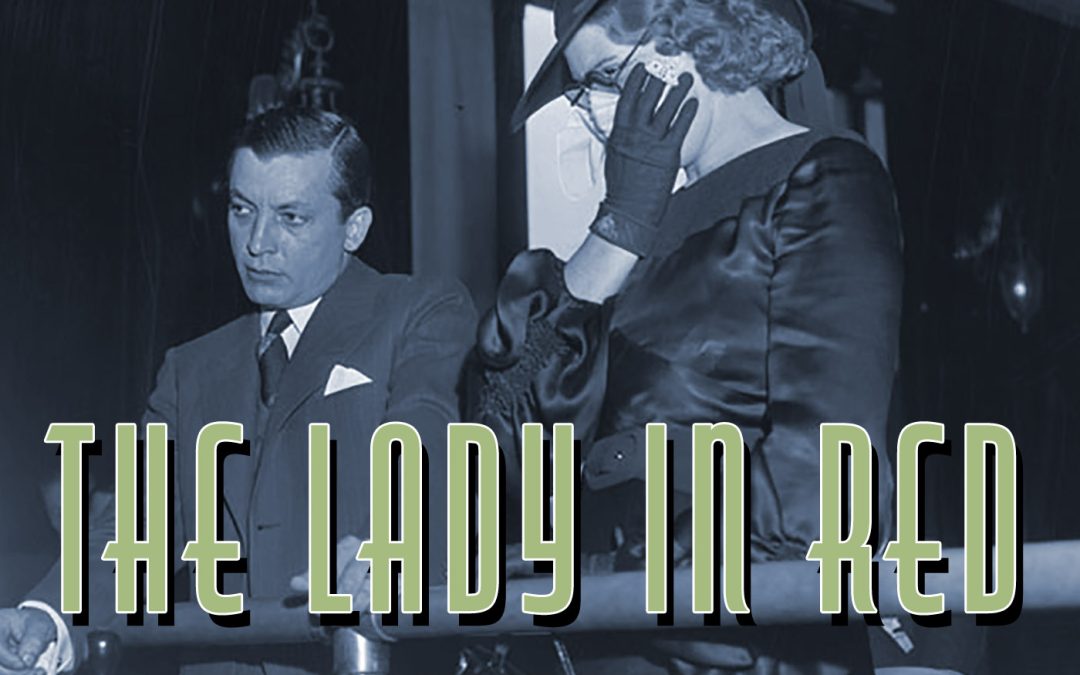
In this episode, I continue the story of Dolly Fine as San Francisco’s long-standing system of tolerated vice begins to unravel in the wake of the Atherton Report of 1937. Police shakeups, grand jury investigations, and rising public pressure tightened the noose the long-tolerated and city-wide machinery of grart, even as those very same players who profited for decades scrambled to protect themselves.
When a police raid on Dolly’s house triggered by a high-society matron’s call to the Chief of Police, caught her son and his friends in her parlor, the response was swift and ferocious: felony indictments, screaming headlines, and officials suddenly eager to prove they could clean house. The men walked free, the broader system went largely untouched, and Dolly—branded the “Lady in Red”—was singled out as the fall guy. Faced with the choice of prison, suicide, or breaking her lifelong code of the underworld and becoming a snitch, she vanished, setting off a nationwide manhunt, or madam-hunt. Her tell-all interview with the San Francisco Chronicle, published after she had absconded, did not help her case, nor Attorney, Jake “The Master” Ehrlichs’ future defense of her crimes.
TRANSCRIPT:
Welcome to the Frisco: the Secret History Podcast. I’m your host, Knox Bronson. I have a wonderful episode for you today part two of the Dolly Fine story, one of Frisco’s last great madams.
In Part one of this story, I talked about the Atherton report on vice and San Francisco’s systemic graft that permeated the criminal justice system from the beat cop to the jailhouse to the DA’s office to the courtrooms to the gambling joints of the Tenderloin and the houses of frolic that dotted the city by the hundreds. The explosive report rocked the city, not really because of the vice itself—Frisco had always been an easy going town in that respect—but how much money had been involved. Atherton, a rather slick operator from Los Angeles, an ex-G-man with the smile of a casket salesman, as one newspaper put it, estimated that the police had pulled in over one million dollars in payoffs over the course of the past year. That’s over thirty million in today’s dollars. Not bad for a little city of forty-nine square miles with a population of 647,000. Remember, this was before the Bay and the Golden Gate Bridges were open for traffic. People still had to come across the Bay to Frisco on ferries.
Remember, too, the the ferry terminal in San Francisco was manned by San Francisco police and if they didn’t like the look of some well-dressed slick ambling down the gangway, if he looked a little too east coast, or especially if he looked a little too Italian, they would pull him into their office and grill him to determine what had brought him to their fair city, which they ran. If they didn’t like his answers, they would put him on the next ferry back to Oakland, causing Al Capone to complain, more than once, that the city was so tightly controlled, no one could break in to the action here. Frank Lanza controlled North Beach, also known as Little Italy. Brothels and gambling joints were spread from Chinatown and what was left of the Barbary Coast over to the Tenderloin. By and large, these establishments operated within the system of payoffs and bribes as administered by the McDonough Brothers, who ran their bail bonds company out of a saloon at Kearny and Clay Streets.
As Sally Stanford wrote in her memoir, The Lady of the House, in 1966,
[typewriter]
“They were a wonderful set of burglars, the people who were running San Francisco when I first came to town in 1923, wonderful because, if they were stealing, they were doing it with class and style. When they turned City Hall and the Hall of Justice into a pair of stores with bargains for all, they did it with charm, finesse, and what the French call “savoir-faire.”
They were the municipal swashbucklers and the civic high-binders. And compared with today’s local statesmen, they didn’t really try very hard to be much else, except just before election.
This is understandable. The politics of the town were dominated by Mayor Jimmy Rolph (Sunny Jim, or Dirty Jim, depending upon where you sat politically), but believe me, he was a doll, a political dreamboat. Say what you will for New York’s Jimmy Walker or Boston’s Jim Curley, Jimmy Rolph wore San Francisco like a tailor-made plaid suit and on him it looked wonderful. Not only did Jimmy do o.k., but the rest of us did pretty well too. For if there ever was a live-and-let-live type, it was Mayor Rolph of San Francisco. At one time in his colorful career, when asked to make a statement about prostitution he said, “Leave it alone; just regulate de a was s motto. Although the old Barbary Coast was gone, the town was spinning just as lustily as it always had ever since the first pirate stepped down the gangplank from his ship, looked around, and ordered a passing Indian to bring on the women.
The Tenderloin was teeming with prosperity. French restaurants with private rooms and acquiescent ladies upstairs abounded. The North Beach or Italian District for years had been given over to the sober intercourses of industrious Neopolitan fishermen, hardworking broken-English purveyors of salami and Gorgonzola, and respectable Mafia types who spent their time playing bocce ball and beating their wives.
Now it bubbled with alcoholic activity. Speakeasies, wine flats and nightclubs were plentiful. Even in the conservative financial district and practically every premise in town where more than three men might congregate simultaneously, a Klondike game awaited, a game of chance where you throw a dozen dice out of a box to a layout, hoping that the proprietor will pay you a certain amount of money in the event that you shoot unlikely totals. Men loved it; no fortunes were lost, and some were made. Made by the proprietors, that is. All this was done pretty much out in the open with God and Jimmy Rolph looking on.
The love business flourished too.
[end typewriter]
[intermezzo]
The Atherton Report didn’t put everybody out of business, but it did put a serious crimp on things. Several high-ranking police officers were forced to retire. Scores of policemen were reassigned to other neighborhoods. Many others in the city’s criminal justice system were impacted. Five cops were indicted, but found not guilty.
Both the Bay and Golden Gate Bridges would open that year, loosening police control over who was entering the city.
The Grand Jury subpoenaed Dolly to grill her about her operations. She managed to escape mostly unscathed, but, clearly, things were heating up in the cool grey city love.
She asked her attorney, Jake Ehrlich, what she should do. He told her that, in light of the Atherton Report’s findings and their effect on public opinion, the ballgame was over, that she should simply fold up her sheets and blankets and fade away.
This was not what she wanted to hear. She decided to move operations from her building at 555 Hyde, signed a five year lease on a much more luxurious building at 1275 Bush and spent $20,000 (almost half a million dollars today) on furnishings—Dolly was, after all, a woman of exquisite taste and was determined to offer her beautiful women in an impeccably decorated boudoir.
What Jake wrote about it was this:
[typewriter]
Apparently the advice she bought so expensively from me matched neither her wishful thinking nor her plans, for she stayed right with the situation and kept her bedding at its usual uses.
Even when she was called to testify before the Grand Jury she wasn’t too perturbed, although I explained to her that the best she could get as the result of such an invitation was an unpleasant and unprofitable draw. And there were other possibilities of an even uglier nature if she should make the not uncommon feminine mistake of verbally fudging a bit while under oath.
[end typewriter]
And so things rolled on, the girls and the men rolled around together, and the money rolled in. Business was good. Dolly would rack up six “courtesy arrests,” as Jake called them in the next six months. Fines levied for all six pinches totaled $75, a little over $1700 today.
That reminds me. In our last episode, Dolly Fine Part One, I highlighted, briefly, some of the great Frisco madams of yore. One was Irene McReady, the first documented madam in the early Gold Rush era, whose partner was James McCabe, co-owner of the El Dorado gambling house at Kearney and Washington, where the daily take sometimes exceeded $200,000 in gold dust. I forgot to mention that $200,000 in gold dust would be the equivalent of $7.5 million dollars today.
That was but one gambling house in San Francisco in the 1850s. Seven million dollars passing through the house on any given day. No wonder adventurers, thieves, flimflam men, madams, good-time girls, argonauts, lawyers, doctors, newspapermen, restaurateurs, printers, builders, hoteliers, importers, and other legitimate businessmen poured into the wild city from around the world.
My great-grandfather, Edward Bronson, would arrive sometime later, in 1887, to sell books by the yard to fill the libraries in the grand mansions of the newly rich on Nob Hill, Pacific Heights, Seacliff and elsewhere in town.
This was the foundation upon which San Francisco was built: vice, crime, and gold. Over the next hundred years, the wildness would be tamed somewhat, but outlaw credo was built into Frisco’s DNA at its birth and, if your haven’t listened to it, I recommend listening to the very first episode of this podcast, titled, “Vice Defined San Francisco’s DNA At Its Inception.”
[intermezzo]
For Dolly Fine, legendary madam of the Tenderloin, April 23, 1938 was the day. all hell broke loose.
Mrs. Dorothy B. Rankin, a wealthy Nob Hill matron, active in the Women’s League of Voters and the Business and Professional Women’s Club of San Francisco and frequently mentioned in the society pages, overheard her sixteen year old son talking on the telephone. He was telling his friend that they were going to go to Sally Stanford’s place after the prom.
As soon as her son got off the phone, she called the Chief of Police Quinn and told him of her son’s and his friends’ plans. Quinn immediately assembled a team to stake out Sally’s place at the appropriate hour for when the boys would arrive after the prom. When Sally wisely turned them away at the door, the boys made their way over to Dolly’s place on Bush street. The police followed them and when had been admitted in to the parlor, they raided Dolly’s den of delight.
Dolly and five women were arrested. The boys were sent home to their parents. The men were allowed to put their pants on and make their ways home in the foggy Frisco night.
[intermezzo]
The last episode ended with a call from Dolly to Jake Ehrlich, who was in Los Angeles the morning after the raid. I’ll let The Master tell the story his way.
[typewriter]
The next morning I bought the San Francisco papers and digested them with my breakfast. They were practically afire. In a nutshell, Dolly was in the wringer all the way to her rib cage. She had been caught entertaining a brood of teen-age boys. The selling of sex to men is a misdemeanor, involving fines and county jail sentences at the very severest and very little actual public outrage. Offering ladies to young boys is a very easy way to break into the penitentiary on a long-term lease in California-and the bitterness of the public reaction is apt to be maximal.
I felt that I knew Dolly pretty well. Although occasionally unsmart, she was never completely insensate; and if not exactly a pillar of society, she was actually a decent woman in the basic human essentials. It didn’t add up for me that she would knowingly do business with young boys. It turned out I was right.
I made a few calls and found out how my client had been sandbagged by fate. In the first place, the “boys” were boys in the same sense that many a hairy-chested, gruff-voiced, dinner-coated youngster of today is still technically a minor although able and allowed to go out on the town for an evening of adult laughs and as much sex as he can get on an amateur basis.
No matter; they were still minors of from fifteen to seventeen years of age—all eight of them—and young enough for one of their mothers to have monitored her son’s telephone conversation with a pal of his on the afternoon before Dolly’s unscheduled professional demise.
“Man, we’re going to really live tonight!” Prospective Sinner Number One jubilantly gloated to P.S. Number Two, and—unknowingly—to his own flap-eared mother. “After the prom, we’re all going to Sally Stanford’s place!”
The guardian angel in attendance on Sally Stanford, my other client in scarlet enterprise, was apparently working a double shift that night. Sally looked the boys over, guffawed heartily at their claims to attainment of early middle age, then threw them out into the cool, post-midnight shadows of Pine Street. Craftily shadowed by the police officers that the eavesdropping mother had set on their coltish trails, the lads dropped down the slope of Nob Hill and knocked on the hapless Dolly’s door.
Here they were met by a Negro maid to whom any gentleman in a dinner coat with bona fide money in hand was a genuine customer in good standing. The maid explained that:
“Miss Dolly is tied up and things is kinda busy but that’s alright, gentlemen, I’ll just put you in the back room and you can sorta rest yourselves for awhile; sort of get yourselves set for a large evening.”
She was so right. The evening turned out to be titanic.
Police Inspectors Bill Merrick and Frank Lucey burst in on the busy little establishment on Bush Street like hungry hounds at a barbecue; alarm bells sent alarmed customers trouserward; priestesses of the temple turned from dulcet overtures to raucous profanity; the housekeeper who had caused the whole hassle locked herself in a john and promptly lost the key; and, according to the San Francisco Examiner, “eight white-faced youngsters” were collected.
The Examiner went on to record the astounded appearance of “a tall blond woman in a scarlet evening gown”—Hence the term Lady In Red that would be Dolly’s sobriquet for the rest of her life— and her first public statement of the moment. It was tersely expressed, piously conceived.
“My God!” she said.
When shown the eight young men whose presence had so dynamically upset the revels , she looked, according to one policeman-“like she’d discovered mice in her wardrobe,” and when she regained the power of speech she made a further disclosure.
“So help me!” she said, “I don’t know how the bastards got in here. I never saw them in my life and I certainly didn’t let them in.”
Merrick and Lucey took the names and addresses of the young men and sent them home to their families. The older and therefore lawful male sinners were poured into their garments and sent in other directions. Dolly was taken to the City Prison in the pie wagon, as were the maid and the girls.
Miss Fine was booked as “the keeper” of a house of ill fame (a strange misnomer for such a gay establishment, to my mind), and the young ladies were charged with being present in such a place, no act of prostitution having been actually witnessed by the police. But no one was under any illusion that the worst was not still to come.
More evil had escaped to torment the conscience of the town than even I had anticipated. I was determined as I listened to this sick, sad prelude to a witch burning that one unfortunate woman would not be made the scapegoat for the guilt complex of a small insensate element of a community that apparently thought that it could wipe its civic slate clean with one single gesture of seeming righteousness.
I was suddenly filled with a consuming determination. I vowed that Dolly Fine was not going to be conscripted as a patsy for the simon-pures, a slang term meaning superficially or hypocritically virtuous, of the community, especially not for those who lived in glass houses. This included a great number who were already reaching for stones. As for me, [and pay attention to what The Master says here] I knew the location of a few good-sized brickbats myself.
One such was particularly on my mind that morning as I climbed aboard the train at the Southern Pacific Depot in Los Angeles and headed back to San Francisco and what promised to be a real fight.
[intermezzo]
The headlines read
[typewriter]
6 A.M. EXTRA
JURY INDICTS DOLLY FINE AS BOYS TELL OF VICE DEN
Notorious Brothel Keeper Must Stand Trial on 8 Charges
Prison and Fines Provided If Woman Convicted
San Francisco’s grand jury, outraged by testimony which fell from the lips of eight juvenile witnesses, voted last night to indict Dolly Fine, notorious underworld character.
They voted to indict her on eight counts, one for each of the boys, under Section 702 of the State Welfare Code providing two years imprisonment and a fine of $1,000 for any person who permits or encourages a juvenile to enter a house of prostitution.
Called to testify before the Grand Jury, the eight boys gave the jury a stammering picture of what occurred in the establishment of Dolly Fine, when they visited it in a group on Saturday night.
They said they were admitted by a Negro maid; that they passed down a hallway, where they saw “a blonde woman in a red dress”; that they entered a backroom. and were being entertained by a Chinese girl when the police raiding party broke in.
The “lady in red’ testimony disclosed, was Dolly Fine. Each of the boys admitted that he had visited the brothel at least once before: some testified to three or four visits. They had become patrons of the establishment, they told the jury, after hearing it discussed widely by older students at their high school.
In addition to the boys, the jury heard Police Inspectors Frank Lucey and William Merrick, who conducted the raid, and Patrolman Matthew Carberry, who produced official records to show the Dolly Fine place had been raided six times within a year.
District Attorney Brady sent the case to the jury with this announcement: “It is ridiculous for the police department to contend that it can not close houses of prostitution. “No house of prostitution will open in San Francisco without an o. k. from the police department.”
Any house will close on orders from the police department. Putting a patrolman at the entrance to any house will establish an effective blockade. “
In other words, the police were also being put on trial.
By invoking Section 702, Assistant District Attorney Harry Neubarth utilized a new legal weapon against brothel-keepers who prey on juveniles. Before this, the only penalty in such cases was that provided for a keeper of a house of ill fame the maximum being six months in jail and a fine of $500. In practice, the penalty was usually a fine of just $25 or $50.
In this case, each violation of Section 702 carried a two-year prison sentence and a two-thousand dollar fine.
Not only did the grand jury indict Dolly Fine, it also began an investigation to determine whose negligence on the part of the police permitted her brothel to operate within 250 yards of the Redding Grammar School.
The Foreman of the Grand Jury, Edward Sixtus, declared:
“The jury will be watching closely to see if the police clean up the situation; otherwise the jury will take further action. Sentiment of the jury was that the indictment should have furnished sufficient incentive for the police to proceed.”
[end typewriter]
It was all-out war.
[intermezzo]
Jake Ehrlich had seen the writing the wall after the release of the Atherton Report just a year prior, in 1937 and had told Dolly it was time . As we know, Dolly had blithely ignored his advice.
The Chief of Police, William J. Quinn, wrote a letter to the District Attorney which read, “All law enforcement agencies must join in protecting youngsters from the moral and hygenic dangers of prostitution. I will be glad to co-operate in every possible way in prosecuting the civil abatement proceedings, the grand jury investigation and any criminal action which may be filed before the Juvenile Court or any other court.”
On the other hand, Capt. Arthur Christiansen, in charge of the Northern District—in this era, police districts were private fiefdoms, much like feudal Japan with police captains as Daimyo, or Lords, and beat cops their Samurai—made a statement to the Grand Jury that the multiple duties of police officers would make blockading each suspected house of prostitution impractical. He added that Dolly Fine’s apartment house had been under police watch and had been unoccupied since the night of the raid.
Nonetheless, obviously under great pressure, Captain Christiansen ultimately put himself at the head of a posse of uniformed men and conducted a series of raids on April 26. The tour included, as the Examiner reported:
977 McAllister street, where two keepers, two inmates, and two visitors were arrested.
1345 Eddy street, which yielded one keeper, one inmate, one visitor, all colored.
944 Fillmore street, one keeper and two inmates.
1584 Bush street, two keepers, four inmates, eight visitors.
1563 Ellis street, two keepers, three inmates and two visitors. In every case, It was “Bail by McDonough.”
I love how the paper refers to the women as inmates, johns as visitors, madams as keepers. I’m sure you noticed that all the men who were caught in Dolly’s house on the night of the raid were allowed to get dressed and leave unscathed while the women were taken down to the hoosegow.
[intermezzo]
The heat was on. District Attorney Matthew Brady announced he was considering using the powerful, long-idle Red Light Abatement Act to “padlock the property” at 1275 Bush Street, emphasizing that the flagrancy of the case justified “extreme measures”. Judge Meikle introduced a tough new schedule for first, second, and third-time disorderly house keepers, threatening $1,000 fines and probable jail time for repeat offenders.
Pete McDonough, who ran a bail bonds company out of his saloon and had run Frisco’s underworld of vice for two decades, announced he would no longer offer bail for prostitutes, panderers, and other habitual offenders. The state had suspended his license to operate his business on moral grounds, in any case, and he claimed that he had been forced to offer bail without interest. He said “”I’m tired of having my name linked with that of Dolly Fine and other offenders. It gives the impression that I’m trying to defy the law. I’m not defying the law. I’m appealing to the law for my right to a bail bond license. “There isn’t anything in the bail bond business for me except a kick in the pants.”
The Grand Jury didn’t believe him and he was still under indictment for providing bail without a license.
Meanwhile, unbeknownst to Jake Ehrlich, Dolly had spilled her guts in a three-hour interview, in confidence, to a Chronicle reporter, perhaps in hopes of swaying public sentiment in her favor.
On April 30, The San Francisco Chronicle published this story on the front page:
Dolly Fine made the most important decision of her life yesterday.
She became a fugitive from justice, hunted throughout the United States, rather than submit to these self-described alternatives:
Reveal to the public what she knows about police graft payments for the protection of houses of prostitution.
Face almost certain conviction and a long jail term on a charge of contributing to the delinquency of eight schoolboys in her Bush street brothel.
Commit suicide.
She told her story exclusively to The Chronicle three days ago, a few hours after her indictment and while she was struggling to make up her mind which course to take.
At that time she turned the various alternatives over in her mind, making it clear that her intention was to face the music.
Then, however, she went into hiding and her ultimate decision did not become known until Judge Meikle convened court yesterday morning.
When her case was called, there was no response from Dolly Fine. It was her way of telling the city she was bowing to the underworld code which says “Don’t be a squealer.”
Dolly Fine was in the wind. A nationwide hunt for The Lady In Red was underway, making front page headlines across the nation.
Stay tuned for Part 3 of the Dolly Fine story. It only gets crazier.
[intermezzo]
Frisco—the Secret History is a listener supported podcast. Main episodes will always be free. Our website is www.friscothesecrethisory.com. Visit the website for show notes. Paid tier members, starting at as little as $5 a month, will receive bonus episodes and other perks of membership. There is a one dollar tier, but that will simply give you ad-free episodes when I get some advertisers.
If you enjoy the podcast, please tell your friends about it, especially those who enjoy San Francisco or true crime history. Word of mouth is the absolute best means of promotion for any creative endeavor in this world of algorithms and the ceaseless barrage of ads, notifications, and appeals on every digital platform. If you are aware of some particular aspect of San Francisco history in the thirties and forties you would like me to research, or have a story to tell, please let me know.
Once again, I’m your host, Knox Bronson.
Thank you for listening. Until next time, please get a little crazy and call it Frisco.