
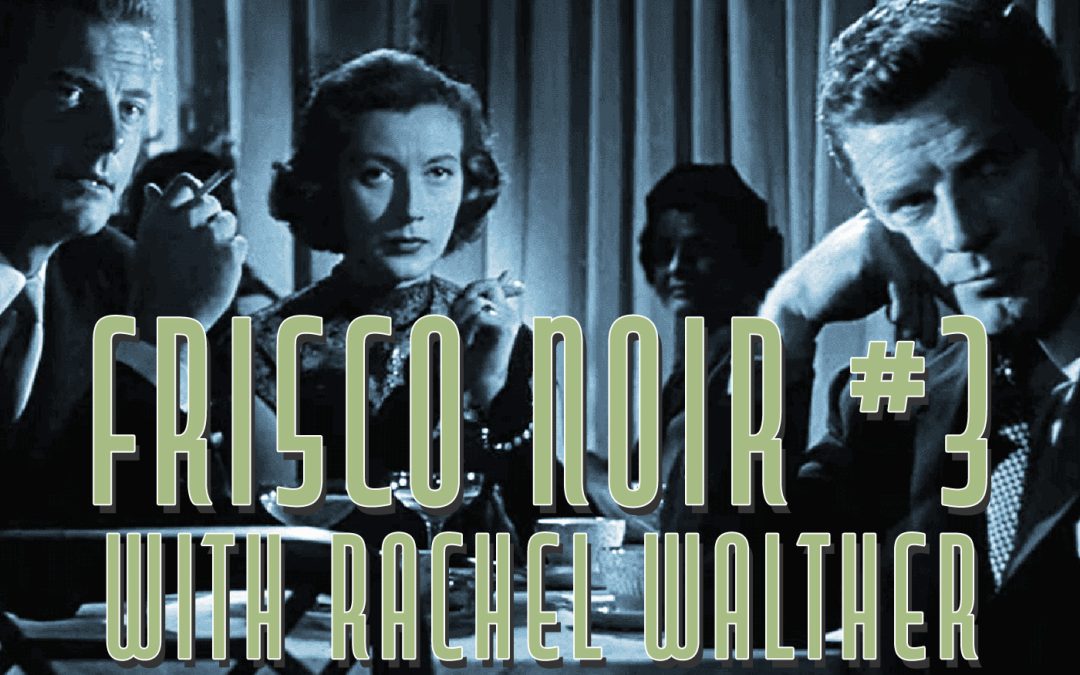
In this episode of Frisco: The Secret History, Knox Bronson welcomes back film writer Rachel Walther to explore two classic film noir movies set in San Francisco: Sudden Fear (1952) starring Joan Crawford and Jack Palance, and House on Telegraph Hill (1951) starring Valentina Cortese and Richard Basehart.
Rachel dives into the production history, fascinating behind-the-scenes drama, and the real San Francisco locations that shaped these atmospheric thrillers. From Joan Crawford’s tense love triangle with her co-stars to wartime backstories and dramatic Telegraph Hill chases, the conversation reveals how the city itself became a character in post-war noir filmmaking.
They also explore why San Francisco’s dramatic hills, foggy streets, and working-class past made it such a natural setting for crime dramas in the 1940s and 50s—and how these films captured a version of the city that has largely disappeared.
If you love classic cinema, film noir, or San Francisco history, this episode uncovers the strange and shadowy stories behind two remarkable movies.
Recorded March 6, 2026.
TRANSCRIPT (Slightly edited for clarity):
Knox: Hi, it’s Knox Bronson at the Frisco: The Secret History podcast. Today we’re talking to Rachel Walther, whom you might remember from two prior episodes where we discussed a couple of famous noir movies set in San Francisco. The Girl From Shanghai.
Rachel: The Lady from Shanghai.
Knox: The Lady from Shanghai. And the first Maltese Falcon.
Rachel: Yeah.
Knox: Rachel is a writer and I’m gonna let her talk for a minute. Rachel how are you today?
Rachel: I’m good thanks for having me back.
Knox: Do you want to just tell us about your your book that is coming out?
Rachel: Oh yeah thanks for asking it’s yeah it’s going to be out by the end of this month. It’s called Born To Lose the misfits who made dog day afternoon and it it traces not only the making of the 1975 film directed by Sydney Lumet starring Al Pacino and John Kazale.
And it also, though, it goes back and talks about the real life, the true crime story that inspired it and how the film continued to influence the people related to the real robbery. That’s very exciting. Oh, thank you. Yeah, I’m really looking forward to it.
Knox: Is there anywhere people can find it?
Rachel: Yes.
Knox: Your website or?
Rachel: Yes. Rachelwalther.com. I’ve got info and all the links to either. You can order it in at your local bookshop. You can get it through Amazon. And it is also available in the UK through all the sellers there.
Knox: Can we put links on the show notes?
Rachel: Sure, definitely, yes.
Knox: We’ll do that.
Rachel: I have a few live events coming up, either readings at bookshops or, more often than not, screenings of the film with a talk or a Q&A beforehand or afterwards. So again, my socials @rwalth on Instagram or my website, you guys can check that stuff out.
Knox: Are those going to happen in the Bay Area or L.A.?
Rachel: A little bit everywhere, thankfully. There’s an event at the Four Star March 19th. There’s an event in early May in Los Angeles, and I’m also going to be showing up in Portland and Seattle and New York later on in spring. So, yeah, I’m taking the tour as wide as I can.
Knox: Great. Do you want to talk just for a moment about the overall history of noir movies in San Francisco, just the elevator pitch?
Rachel: Yeah, I mean, San Francisco really became a favorite location for directors working in the crime and thriller genre. I mean, it wasn’t known as film noir until sort of later on, but with the new style of, with the new topic of films that were cropping up during the war and then particularly after the war, whereas these downbeat tales, thrillers, people down on their luck, or crime-based stories, a lot of it was this dark kind of visually brooding atmosphere, lots of light and shadow, lots of hard-nosed characters, and San Francisco was a real natural fit, both thematically and visually, since at the time San Francisco was very much like a working-class town.
It was very much pre-Silicon Valley, pre-hippie, though it was the gateway to the east. So a huge waterfront industry, lots of just work-a-day folks, a big community of immigrants from Asia all over and well as other parts of the United States and Mexico. And so it was this West coast melting pot. And a lot of the filmmakers sought out San Francisco, either because it had this more sort of worldly all over the place feel to it, like a lady from Shanghai.
Rachel: And also it’s just really visually dynamic anywhere. Anytime you set up a shot in the city, you’ve got a great hill in the background and amazing skyline. And it’s also a little bit hallucinatory, which feeds in when you’re dealing with characters who have a lot of unstable personalities or unclear motivations. The landscape really was a natural ally for tales like that.
And not too far away from Hollywood, too, so you could get out of town without having to have big production costs.
Knox: Well … what two movies are we talking about today?
Rachel: Two of my favorites that were shot in the city during the early 50s. One, Sudden Fear, starring Joan Crawford, and then another, House on Telegraph Hill, which sort of as advertised right in the title, it’s very much a San Francisco-based story. And so, yeah, to start, Sudden Fear came out in the summer of 1952, and it was really a Joan Crawford project from the beginning.
[insert Sudden Fear trailer audio]
She camped out at her vacation house with a stack of scripts and finally came across this story, this book written by Edna Sherry, and she stayed up till 4 a.m. reading it, partnered with a producer who had already nabbed the rights to it and was developing a vehicle, not so much for a … I don’t know if you’d call it a reinvention because she’d already kind of had one reinvention when she was in Mildred Pierce several years before. She had had a series of bombs at MGM, late 30s, left the studio. Her first movie at Warner Brothers was Mildred Pierce. She won the Oscar. So she was back at this time. So throughout the late 40s, she was at the top of the box office again.
But the parts had started to get a little more so-so, I guess. Warner Brothers was sort of just slamming her into whatever vehicle they knew her name would sell. And so she was getting restless, and she wanted something that was quality. So this story of a wealthy heiress who was also a famous playwright …
And she gets involved with a much younger man who may or may not actually love her or may or may not be with her just for her money. That story really appealed to her. And so she started developing it with director David Miller, kind of just a journeyman director. And so the production history with that, things fell into place rather quickly. The casting was pretty straightforward except for when it came to her leading man, her counterpart in the film.
She was wanting, you know, like Clark Gable or someone sort of as famous as her and of her standards. And the trouble is, is the characters in his late 20s, maybe early 30s, and Crawford was at least, you know, mid to late 40s at that time. And so David Miller came over with some suggestions one night over dinner, and he screened her this film, Panic in the Streets, that had just come out, starring Richard Widmark, Jack Palance. It’s also a really great film noir story set in New Orleans.
And so, you know, two-thirds of the way through the movie, Crawford’s like, “oh, okay, you know, are you thinking I should have Richard Widmark as the co-star, or what do you think?”
He’s like, no, no, that guy. And he points to Jack Palance, and she got furious. She stood up, stopped the movie, get out! She threw him out of the house. She was so offended at the suggestion that he would cast, he would want someone like Palance, who had a very, really strange look about him.
I can’t even know how to… How would you describe Jack Palance’s look? Like, it’s so…
Knox: I thought he was perfect. Yes. Very strange bone structure and just an aura about him. I thought he was … perfectly smarmy, and you could just see the deceit behind his eyes when he would talk to her and try to pretend he was the loving husband and all that.
Rachel: Yeah, I think bone structure is the way to put it. He had this real unusual look, and there’s a lot of rumors as to how his face came to be, whether it’s natural or … Oh, yeah, the rumor is that he, you know, forgive me, I cannot remember if he served in World War II or Korea at this…
Knox: World War II.
Rachel: World War II, yeah, with the age. So there’s one story that he was a pilot and he was gunned down, and so his face is a result of scarring during that accident. He always maintained that that’s just the way he looks, but that was not what Crawford was used to. She was used to men that were much more handsome, but Miller argued, and he finally won her over. He apologized, came back. They had some more conversations about it. He said, you know, with this movie.
He’s like, “Joan, you usually play the female character and the male character, and we can’t really have that for this movie. We need someone who, like you said, has that menacing quality, that threat, which really came through in Panic in the Streets.”
So she relented, she said okay, and then life sort of imitated art in the sense that the film is about a woman who… the first opening scene of the movie, Crawford’s character is arguing that she does not want Palance’s character cast in her new play.
And so that’s sort of the meet cute setup in New York. And so it’s only on when they’re both coincidentally or not on the train together, heading back out to San Francisco that they meet up, she’s charmed by him and they develop a romance.
So by the time they arrive in San Francisco, they’re an item. And Crawford had a habit of getting together with her leading man. That was sort of her preferred way of working, I guess you could say.
And he had other ideas. He was a little intimidated by her, but he was also much more keen on his other co-star, Gloria Graham, who plays his illicit love interest in the film.
So Palance and Graham had an affair during the production.
Crawford knew about it and was really upset that he was, that Palance preferred Graham to her and so Miller knew that all this was going on behind the scenes as well and he really played that up and I think you can see all of that in the dynamics of the story yeah so it’s I mean honestly the most of the plot it’s a bit of that woman in peril tale where she thinks she’s in love with this young wonderful man who isn’t with her for her money and they just go about their lovely life and she stumbles on a recording that she’s not supposed to hear of Palance conspiring with Gloria Graham as to how to best kill her before a new will goes into effect.
And so from then, the ferocious Joan Crawford comes through, and there’s a lot of scenes that don’t have a ton of dialogue to them. It’s her just kind of plotting and planning, and so you know to an extent what she might do to get out of the situation.
But some of it is a mystery still, and so you’re left to just watch how this all unfolds. I think part of that’s the credit of the screenwriter, Lenore Coffee. She’d been one of the few lady screenwriters who had been around since the silent era, but she really did know how to write visually. So a lot of these amazing scenes of Crawford running around San Francisco or these sumptuous interiors were in the script that Coffey put in because she knew how to angle things and how to shoot.
Knox: It is an incredibly visually beautiful movie. And can you talk about the locations?
Rachel: Yeah. Crawford’s house is at, well, ostensibly, you know, it’s supposed to be at Scott and Green in Pacific Heights. And that shows, I think, that you had to be rich to live in San Francisco even then, or, you know, to live in San Francisco in a way that was visually entrancing.
In the film, Palance gets an apartment right on Lombard Street, right in the windy part. So there’s a few scenes where she’s dropping him off on this insane, snaky street, which again, I think just goes to the subtext of all of his twisty motivations.
And then Graham, she’s at Gloria Graham’s apartment, I think is really interesting. It’s at, on 1201 Greenwich in Russian Hill. And I don’t know if this, if this stuck out to you, but Gloria Graham’s apartment, she’s just a single lady. She ostensibly grabbed an apartment really quick. She’s just arrived in the city. It must have four bedrooms to it. I don’t know. Part of it is there’s a lot of scenes at the end where the action takes place in her apartment, but it seems much too large for one lady to live in that place.
I don’t know if she’s got unseen roommates or what’s going on there. And also there’s a really great sequence where … Palance and Graham have an illicit meetup at the Legion of Honor. So, I mean, I think that those are rear projection shots that were done in the studio, but you do get to see in a way, like pretty much how much the Legion of Honor has not changed since that time. That’s one of those like iconic standbys of the city.
Knox: Were most of the interiors shot on a set?
Rachel: Yeah. They did all the interiors on the sound stage just to have total control over the lighting and for cost reasons, just so that they could keep everyone local. And there’s this amazing sequence at the end that goes up and down Pacific Heights and the Russian Hill neighborhoods. But I don’t know if you, and hopefully maybe you didn’t catch this because they did it pretty seamlessly, but towards the end of that big final confrontation where it’s Palance is chasing Joan Crawford on foot and she’s running into various doorways to escape him.
They’re in Pacific Heights, they’re in Russian Hill, and then suddenly they’re in Bunker Hill in Los Angeles. There’s a few dead giveaways with the tunnels that I think noir fans who’ve raised on Criss Cross and Night of a Thousand Eyes, there’s a few telltale visuals that were only in the Bunker Hill neighborhood. So I don’t know practically why they had to make that switch, but that’s sort of where it ends up. But they glue it together in such a way that it’s pretty seamless.
Knox: Was Joan Crawford involved in the development of the script?
Rachel: Yes, definitely. I mean, she had script approval, put it that way. I don’t think she didn’t meddle. She let Coffee adapt from the book pretty freely. And I believe she was very happy with it. So she didn’t have many adjustments. But she certainly made sure that, you know, she … All the technicians on set were her preferred folks to work with to make sure that she was shot and lit appropriately. And definitely start to finish a Joan Crawford vehicle. I think especially there’s an amazing end shot where she’s kind of sort of casually walking away from all the chaos that has just ensued with the final scene.
But her character in the film is, for me, a little different than usual. Usually she plays these hard-nosed … working-class girls that are working their way up to a level of status. And so to play a woman who’s a little softer, she’s an heiress, she’s also successful in her own right, but she’s a woman who’s never not known money. So she is a little more helpless and scared, I think, than she typically allowed herself to be seen. Joan Crawford was really … At another hinge in her career at this point. You could, I think, argue Sudden Fear is either the last of her kind of Warner Brothers golden age, even though this was with Fox, or maybe the beginning of roles that started to veer more into camp. After this, she did … sort of a so-so musical torch song. Then she did Johnny Guitar, which definitely has become a cult favorite. But it’s really during this handful of films that she develops that later 50s, harsher Joan Crawford look, like with the shoulder pads, the scar of lipstick, with just a line for her mouth, big eyelashes.
In Sudden Fear, you definitely see bits of that creeping through. And to sort of tie up that soap opera a bit of it so you know she had developed an animosity toward Gloria Graham since Palance favored her during the filming of the movie Crawford got her revenge because while they were shooting while she was shooting Johnny Guitar with director Nicholas Gray who happened to be Gloria Graham’s husband she had an affair with Nicholas Gray … so it just it seems like there’s only 20 people in Hollywood and they’re all running around it’s it’s never changed that’s incredible!
Knox: How was the movie received?
Rachel: Pretty good. It got really good reviews. Folks enjoyed it. And it’s just such a great, it’s one of the best film noirs, I’d say, top 20. And both Crawford and Palance were nominated, as well as, I want to say, the cinematography and the costumes.
Nobody won. And so, yeah, Crawford lost. Interestingly, Bette Davis was also nominated that year for The Star, which is a movie that some folks have rumored was sort of based on Joan Crawford. So, again, that’s a different sort of rivalry that was going on. Shirley Booth beat them both in Come Back Little Sheba, which is sort of, you know, one of those movies folks don’t watch that much anymore. And then, as another little zing, Gloria Graham won Best Supporting Actress, but not for Sudden Fear. She won for Bad and Beautiful.
Again, it’s like how many people were working in Hollywood at the time. Everyone’s up for all the same stuff. And then Palance lost out to Anthony Quinn in Viva Zapata, which made sense. Yeah, Anthony Quinn was really exploding onto the scene at that time.
Knox: Is there anything else to say about the movie?
Rachel: Yeah.
Knox: I’ve only watched it once. I loved it. It was totally entranced.
Rachel: Oh, I so recommend it. And at least as of when we’re talking about it, it is … available streaming free like if you have a library resource through Kanopy so …
Knox: it’s on YouTube.
Rachel: Oh good to know yeah and and then if you like then … we could segue to House On Telegraph Hill excuse me which just came out the year before that it was another film that really amplified San Francisco’s profile as the go-to place for these types of stories.
Knox: Actually, you can find both movies on the FriscoTheSecretHistory.com website, along with all the other episodes of the podcast.
Rachel: Oh, that’s a one-stop shop. Let’s talk about The House on Telegraph.
Knox: Yeah.
[insert Sudden Fear trailer audio]
Rachel: Yeah, since the house is such a big character in it, to start with the location stuff on that. So ostensibly the house, which doesn’t really exist and never existed, was supposed to be at 200 Jackson Street, right? Sort of at the edge of Telegraph Hill. But there’s so many amazing sequences in the film where there’s the main character, Valentina Cortesa, and her son. They’re playing in the house’s backyard, which is actually the back lawn of Coit Tower. That was something I’m like, wait a minute, I know this, I know this lawn, I know this view. So it’s this amazing circular hedge with the great view of the Bay Bridge in the background.
And The House on Telegraph Hill is, it’s a really interesting story. And it was one that hadn’t been told in Hollywood too much at that point. As the film opens, Valentina Cortez’s character is caught up in the war in Europe. She’s of Polish nationality.
And her character, as I should say, Cortessa, was Italian in real life. And she ends up in Belzen in the concentration camp, which they had not to pick concentration camps literally or even mention them too much in the early 50s. It was something that people were very much anxious to not think about anymore. But it’s such a motivating factor as to why her character does what she does.
In the camp, she befriends a woman who has contacts out on the West Coast of the city and some documentation, paperwork, things like that. So if that woman can survive the war, she’ll be able to have safe refuge in the States. Her friend dies, and so Cortesa adopts her paperwork, adopts her personality and over the course of several years makes her way out to the West Coast and to San Francisco. And interestingly, a lot like Sudden Fear, the film opens in New York. So both of the movies I thought was nice. It starts in New York and then there’s this long train journey.
So it really sort of prepares you for this dazzling moment when you get to the West, which is this land of where everything’s sort of supposed to be at the end of the rainbow. She meets one of the men handling, which is now sort of ostensibly her aunt, in quotes, you know, her friend’s aunt, managing this large estate that she has inherited as, you know, she’s pretending to be this woman. And the actor is played by Richard Basehart. And so she befriends Basehart on the East Coast.
They have a romance whirlwind romance. They get married so by the time again similar to Sudden Fear they show up newly married having a honeymoon time in San Francisco.
She moves into the house which was her aunt’s. Basehart’s living there as well. He’s a relative but by marriage so it’s not creepy and she also has an eight nine year old son that she hasn’t seen and so Cortez is really torn because now she has this makeshift family, but it isn’t really hers. It’s her friend’s.
She’s concealing the fact that she stole this woman’s identity because she’s really just trying to survive. She was in a displaced persons camp in Europe with no options on her own. So she’s stepped into this other woman’s life.
And she feels guilty about it. They also show that she has some nightmares and flashbacks from the war, which is really interesting to see. They don’t push that as much as they maybe could, but it’s an interesting plot point to add into a film noir. And as the course of the film progresses … she begins to suspect that her husband, there’s some things that are not adding up, that either he’s not quite in love with her, maybe he’s having an affair with the nanny, the woman who’s been tasked to raise her son all of these years, but it’s really hard for her to determine whether her suspicions are due to her PTSD from having had all these terrible experiences in the camps, or whether Basehart is in fact someone who’s not who he claims to be, and someone who’s with her for the money and for the security of this big house on the hill.
Knox: Well the interiors are absolutely phenomenal.
Yeah i think it’s … i do you know specifically is that a barbary coast house per se the it’s very ornate it has that old san francisco feel to it.
Knox: I think the outside became um a restaurant
It was a restaurant at the time. Yeah, but the interiors are actually sets. Correct, yeah.
Knox: Yeah, it was a restaurant. I had dinner there a couple of times in the 70s.
Julius’s Castle.
Knox: Julius’s Castle, that’s right.
And they actually physically built a facade in Los Angeles to sort of click on to Julius’s Castle because they liked the main shape of the restaurant, I guess, and also its location. It was at 1541 Montgomery. So they brought a facade in the night. They drove it up.
They set it up in the morning at dawn so that the cinematographer could shoot everything he needed for that. So to me, it also has like that, what do you call it? Almost like a Psycho, the house in Psycho, where it’s like up on the hill, sort of from that same era.
Knox: It’s just, it’s visually stunning, the whole movie.
Rachel: Oh, you know, cinematographer Lucian Ballard was one of the best, and he was married to Merle Oberon, so he really knew how to shoot beautiful women well. And the film was really designed as a vehicle for Valentina Cortessa.
She had done a lot of movies in Europe and she had sort of been headhunted by Daryl Zanuck to come out to Hollywood. This was, I want to say, her second or third movie out in California, but this was really her first… I mean, she’s almost in every scene in the film. It was really designed for her. They made dozens of costume changes … everything to amplify her, which is interesting because she’s not some glamour puss. She’s actually a very normal, interesting-looking woman, but not this, you know, sort of hotsy-totsy type.
And also just her personality … herself, Valentina Cortesa, was not a … she was not a hungry Hollywood starlet. She had gone to Hollywood just kind of reluctantly. And the course of her experiences there didn’t really … she did not warm up to it.
Part of it was she had a hard time learning English and … just mastering the dialogue throughout the film was a big struggle for her. So they had to do a lot of retakes. I mean, I think she does great, honestly. But they had to do a lot of takes to get the dialogue intelligible. Sometimes she had to overdub later.
But one really exciting thing that came out of that film was her and Baseheart fell in love over the course of the film.
I mean, he had just been widowed. He’d been married for 10 years when he’d started out on stage. And his wife had died of a sudden cerebral hemorrhage the year before. So he was still grieving. She was maybe in her mid-20s, but they really didn’t want to make a big deal out of the fact that they had started to have feelings for each other. So no one on set knew. It wasn’t in any of the gossip rags. They really kept it out of the limelight.
But shortly after the film wrapped, Cortez’s next project brought her to London. Basehart deliberately took a project, Decision Before Dawn, that would take him out to Germany. And over the course of the next six months, they got married in London. The cat was out of the bag. They were an item and they tried to make a go of it as a Hollywood couple, but Valentina Cortez just really couldn’t stand it. She couldn’t stand being there. She didn’t really see much of a future for herself. So she actually convinced Basehart to decamp to Europe, to sort of give up what was then a burgeoning career for him. He was finally just starting to get starring roles. She convinced him to quit Hollywood and start making films in Europe. And that’s how we end up seeing him in these now classic films, Italian films like La Strada, Il Badone. He made a lot of movies in London too but it the fact that the two of them were cast in this film altered the course of their lives now.
Knox: Who’s the nanny
Rachel: She is Faye… Oh, gosh, I’m trying… Why am I spacing on her last name? Faye Baker. She… I think she’s great in that film. And that role, I think, was one that had been earmarked for Audrey Totter. That’s who would, like, kind of a film noir staple. And I think Totter would have brought a lot more… You would have known immediately what type of person that character was if Totter had been in the role. But Faye Baker was a little more … mysterious. I thought she did that really well. And there’s the production code necessitated that her character get dealt with in a very particular way. The ending of the film,
I won’t spoil it, but there’s a big dramatic ending where the true nature of the relationship between her and Richard Basehart’s character is revealed and it ends up much more fatally in the original script.
The production code necessitated that Faye Baker sort of survive and have her actions dealt with in a more just way. Put it that way, but she that’s a very interesting element to the film that I think they maybe don’t play up as much as they could that there’s this love triangle situation happening between Cortez’s character her husband and this other gorgeous woman who’s walking around the house taking care of their son
And William Lundigan, actually, is another… I guess maybe it’s a love square, because he’s…
Knox: He was the lawyer?
Rachel: Yeah, he plays a rival to Basehart’s character, sort of a man, you know, sort of a friend of the family, ostensibly, who develops an interest in Cortesa and helps her through the mystery of whether or not her husband’s trying to kill her. And he’s kind of … I don’t want to call him bland because I find him appealing enough, but there’s, he’s delightfully bland maybe would be the way to put it. But he is also, you get to see a lot of great San Francisco locations through her meetups with that character. His office building is downtown at the Crocker building, which I was at like at Market, Post and Montgomery. There’s some great exterior shots of old San Francisco around then and then they end up meeting at the Union Grocery, which is high up on Union Street, so you get these amazing views looking east of Telegraph Hill.
There’s also an amazing sequence in, I think, what’s ostensibly supposed to be the Forbidden City nightclub. There’s this great …Chinatown nightclub interior. And then there’s a shot where, not shot, excuse me, a whole scene where the two of them are meeting at the Marina, the Marina District, like right where all the yachts are. So you look one way, you can see the Palace of Fine Arts and the Golden Gate Bridge. And then you look the other way and you’ve got Nob Hill, Russian Hill. So it’s Robert Wise, the director, he really put his foot forward of wanting to find locations that weren’t too stereotypical, things that actually gave you a sense of what it might be like to look and feel of being a resident of the city at that time.
And that movie, I don’t think it had as high a profile as Sudden Fear. It sort of came and went a little more. I was listening to some of the commentary that Eddie Muller provided for the film when it was released on home video, and he made a good argument that Robert Wise maybe pulled his punches with the story a bit. It could have been a little more dramatic and a little more zesty, but Wise sort of, he shot what was there and he made the most of it, but the film, it sat more the mystery camp than in the sort of the psycho relationship drama thing that might have been maybe more appealing, whereas Sudden Fear totally steers into the psycho wildness of the interpersonal drama.
Knox: I found it totally enjoyable.
Rachel: Yes. I think, and I think one of the best and most enduring aspects of House on Telegraph Hill is its locations, and the fact that it sits in the city so much. And then there’s this great sequence where Valentina Cortessa is driving at the top of Telegraph Hill, and her brakes don’t work in her car, so she’s zooming up and down San Francisco. That was all shot on the streets, you know, Union and Montgomery. Up and down. You can kind of tell sometimes she’s going in one direction and then the opposite direction. Like, if you know the city well.
Knox: She was coming down from Coit Tower, windy.
Rachel: Yeah. So, yeah, they really made a meal out of that whole chunk of the city. And sort of, again, reinforcing that attitude. You know, she lives in this big house at the top of the hill. It really helps to live in the city if you have a ton of money. You get the best views and you get chased in the best neighborhoods if you’re a rich woman in the city.
Knox: Yes. Some things never change.
Rachel: Definitely, yeah.
Knox: You know, my great-grandfather came to San Francisco in 1887.
Rachel: Oh, my goodness, wow.
Knox: With his family. He had four children at the time, and he sold books by the yard to newly rich gold miners and everybody else who was getting rich. There was so much money in San Francisco at the time.
Rachel: Oh, wow.
Knox: Yeah, just to fill their libraries. And my grandfather was born in 1900, And they lived through the earthquake and fire.
Rachel: Wow. And they stayed.
Knox: Well, yeah. So anyway, but it’s, I mean, there’s always been a very wealthy, there was so much money in San Francisco from the very beginning. And it’s still there. As are the mansions.
Rachel: Yes, I definitely am looking forward to, you know, as your show progresses and perhaps we start talking about films in the later periods, we will see a normal apartment at some point. Like Jimmy Stewart’s apartment in Vertigo is… We can get to more normal where it’s detectives or, you know, Clint Eastwood’s character has a normal apartment in Dirty Harry, but that’s decades down the road.
Knox: So how was The House on Telegraph Hill received? I mean, did it have a good run and …
Rachel: So, so, yeah, it didn’t, it didn’t sort of raise to the level of Oscar contenders. It was, it did well, but it sort of came and went, honestly. I don’t think it was, it was not quite a programmer, but it did all right. I mean, like I said, Baseheart was still making a name for himself, so he wasn’t a household name, and neither was Valentina Cortesa. They were really trying her out, and I think partially due to the fact that … Within a few years, you know, this was the last film that Cortessa made for the studio.
And then, you know, Baseheart left as well. It’s a bit of a curio.
Knox: That was her last movie she made in the United States?
Rachel: That’s a good question. Maybe not technically, but the last she made at that time for RKO. Or no, excuse me, I’m mixing it up with Sudden Fear. It’s the last she made for Fox.
Knox: Yeah.
Rachel: Because, yeah, like I said, the next one was, I believe, an independent production in England. And she had a really long and storied career. I want to say she eventually sort of became a resident actress at a big theater in Milan, say in the 80s and 90s. So she eventually segued into doing mostly theater, but she lived into her late 80s.
Knox: Did they live happily ever after?
Rachel: No, I’m sorry to say they didn’t. I think they had a good couple of years in Italy, but they did split by 1960. I mean, here and there, Basehart would come back to Hollywood. He was in John Huston’s Moby Dick. He was in that Brothers Karamazov version that Richard Bricks did. But I think kind of perhaps more on her part than his, they did divorce in 1960, but they have a son together, and so he would …
So he really wanted to be in Hollywood.
Knox: That was his home base.
Rachel: Well, I think it’s just he didn’t, even though he had, you know, glimmers of success, you know, say being in La Strada, still in more of a supporting role way. I can imagine he always had that what if quality of like, what if I had stayed? But to be fair, I don’t, I’ve never heard him in an interview mention that he regrets doing things the way that he did. But he did, yes, promptly come back to Hollywood afterwards. And so that’s, I think, folks remember on the Voyage to the Bottom of the Sea, or I think I’m getting the title slightly wrong, Voyage to the Bottom of the Sea?
Knox: Well, there was 20,000 Leagues Under The Sea.
Rachel: Well, I know there was a TV show in the 60s that he played the sea captain. So he’s sort of known by like a couple generations as this older fella. I remember his name when I was a kid. Yeah, and so he kind of promptly picked up where he left off, and she stayed in Europe. I mean, she worked for Antonioni. She did sort of segue into mostly supporting roles as well. Yeah.
(0:35:20) Yeah, both had very interesting lives. Yeah, sad they didn’t stay together. I’m glad they had a few years together. That’s more than some people, that’s for sure.
Knox: Absolutely. Anything else you want to share about The House on Telegraph Hill or Sudden Fear? Rachel: Gosh, no. I mean, thank you so much, Knox, for having me on so I could showcase these two films that really put San Francisco front and center. Yeah.
Knox: Well, thank you, Rachel. I just love, I learned so much listening to you. It’s really a new era, a new thing to me as I’ve been researching this podcast and just learning about the nature of how the city actually was back in the 40s. Yeah. It basically was an open town up until 1953. And it had been starting to close it down in the late 30s. But up until, like, 1937, the cops ran the town.
Rachel: Gosh, yeah.
Knox: They pulled in $1,200,000 in graft payoffs alone from gambling and prostitution. And there was a small mafia contingent up in North Beach, but it was contained there. But that’s $30 million in today’s dollars. And not bad for a city of 647,000.
And then the bridge’s opened up, and the cops couldn’t keep the East Coast and Midwest Mafia out of the city, which they’d managed to do for so long.
Rachel: Oh, interesting. I didn’t realize that the bridges had such an important role in opening things up, literally.
Knox: Well, they had a police unit at the Ferry Terminal. If any guy came off the ferry and looking a little too like an East Coast wise guy or too Italian, they’d quiz him. If they didn’t like what he said, they’d put him on the next ferry out.
Rachel: Oh, jeez Louise. Yeah, so…
Knox: But, yeah, so it’s just, I mean, I think that’s another aspect of San Francisco, a profoundly weird town, but I think it imbues that quality in these movies.
Rachel: This is just this little quirk. It’s something I always look for in films when I know it’s, or like the two films we talked about today, where it’s folks traveling from the east coast and taking the train to san francisco you can’t take the train to san francisco you have to get off either in oakland or emeryville depending on what train you’re taking so i always check to see if the movie shows them taking the ferry which is what you’d have to do to get over or taking a bus or you know what that connective path is to get usually they just gloss over it and they’re just in the city but the movies that go that extra mile to show you that are nice.
Knox: Well, I think that’s it for today.
Rachel: Thank you. Thank you for listening.
Knox: We’ll have to, you know, put our heads together and come up with a couple more movies.
Rachel: Oh, it’s endless.
Knox: But I really appreciate it. And I hope, please check out the show notes for links to Rachel’s book and her events coming up or her website. And so you can see her somewhere.
So thank you, Rachel.
Rachel: Thanks. Talk to you soon.
Knox: Okay, bye. Thank you.
Knox: Frisco—the Secret History is a listener supported podcast. Main episodes will always be free. Our website is www.friscothesecrethisory.com. Visit the website for show notes. Paid tier members, starting at as little as $5 a month, will receive bonus episodes and other perks of membership. There is a one dollar tier, but that will simply give you ad-free episodes when I get some advertisers.
If you enjoy the podcast, please tell your friends about it, especially those who enjoy San Francisco or true crime history. Word of mouth is the absolute best means of promotion for any creative endeavor in this world of algorithms and the ceaseless barrage of ads, notifications, and appeals on every digital platform. If you are aware of some particular aspect of San Francisco history in the thirties and forties you would like me to research, or have a story to tell, please let me know.
Once again, I’m your host, Knox Bronson.
Thank you for listening. Until next time, please get a little crazy and call it Frisco.