
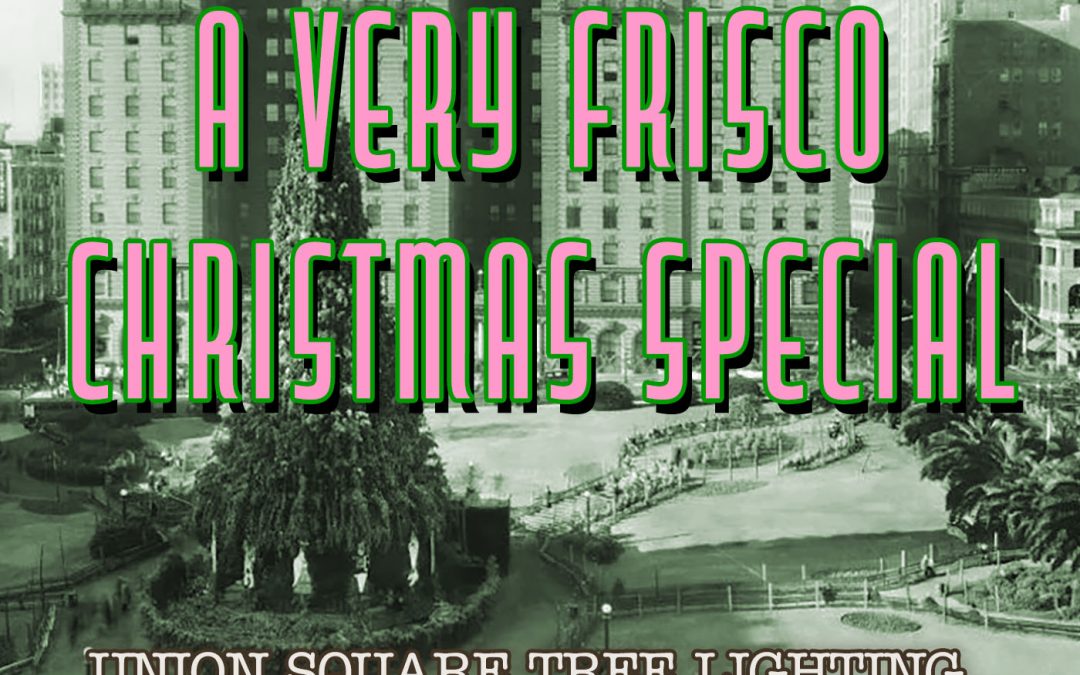
This special holiday episode of Frisco — The Secret History explores how Christmas was celebrated in San Francisco from the Gold Rush through the 1940s. The episode opens with a reflection on Emperor Norton, the city’s most beloved eccentric and an early, outspoken champion of civil rights, whose proclamations stood in stark contrast to the exclusionary realities of his era.From there, the story traces the evolution of Christmas in San Francisco: from the rough-and-tumble mining camps of the foothills, where celebrations could stretch on for days, to the rise of elaborate urban traditions centered around downtown department stores. Listeners are taken inside the origins of iconic holiday spectacles at City of Paris, the transformation of Union Square into a month-long winter festival, and the Emporium’s famously extravagant rooftop attractions.
Blending archival newspaper accounts, civic history, and wry observations, the episode captures a distinctly San Francisco version of Christmas—equal parts spectacle, improvisation, excess, and absurdity—set against moments of hardship, war, and rapid change. The result is a vivid portrait of how the city celebrated the holidays while remaining unmistakably, and sometimes unruly, itself.
REFERENCES
Sutter Creek Foundation December Newsletter 2019
SF Standard—Christmas Department Stores of the Past, December 23, 1923
Emperor Norton Trust—Was the Union Square Christmas Tree Really Emperor Norton’s Idea? December 18, 2018
San Francisco Examiner, December 24, 1946
Herb Caen, San Francisco Chronicle, December 24, 1946
TRANSCRIPT
Welcome to the Secret History of Frisco Podcast. I’m your host, Knox Bronson.
It’s that time of the year and it occurred to me that I should do a Christmas episode. Yes, a Christmas episode. I know the term is not inclusive in the modern sense of the word, but we are talking about a bygone era.
During the rough-and-tumble Gold Rush era and beyond, inclusion was not particularly a priority in Frisco. That said, let us never forget the declamations of our most beloved son, possibly the most famous San Franciscan of them all, Emperor Norton, from that era.
Emperor Norton was an adversary of corruption and fraud of all kinds.
He was a persistent voice for the fair treatment and enhanced legal protections for immigrants and racial/ethnic minorities.
He demanded that African Africans be allowed to ride public streetcars and that they be admitted to public schools.
He commanded that the courts allow Chinese people to testify in court; and he pronounced that “the eyes of the Emperor will be upon anyone who shall counsel any outrage or wrong on the Chinese.”
He proclaimed, with respect to Native Americans, that all “Indian agents” and other parties connected with frauds against “the Indian tribes” were to be publicly punished.
He supported women’s right to vote.
Emperor Norton was a spokesman for all true San Franciscans, and for all time, a hundred and fifty years ago.
[Italian Christmast music]
Nor was inclusion given much thought in the Thirties and Forties, the era upon which this podcast is focussed.
That said, I want to share a conversation I had with Luciano Repetto, owner the the Graffeo Coffee Company on Columbus Avenue in North Beach a couple years ago.
Graffeo Coffee is one of the oldest coffee roasters in the country, and one of the best. Their magnificent dark roast is certainly my favorite coffee bean. I sometimes drive over to San Francisco from Oakland where I live to pick up a pound or two of beans and to visit my very fondly remembered old neighborhood. Someday, I’ll be doing episodes about Frisco in the 1970s and I’ll share some stories.
On that visit a couple years ago, I mentioned to Luciano that I had lived around the corner fifty years ago and used to buy coffee beans from him back then. We started talking about the city and how things had changed.
He said, “We used to have the most diverse population in the world. Now we have a bunch of millionaires talking about diversity.”
Indeed.
Before we get back to Christmastime in Frisco, I want to mention that you can buy Graffeo coffee beans on their website. Www.Graffeo.com, G-r-a-f-f-e-o.com They have three roasts, light, dark, and Swiss water decaf, whatever that is. I myself buy whole dark beans, but they will happily grind your order to your specification. If you are a coffee lover as I am, you really should try Graffeo Coffee at least once before you exit this mortal coil. (I edited this out of the podcast. It sounded too much like a paid advertisement. I assure you it is not. I simply love Graffeo Coffee beans.)
[Christmas music]
Christmas in Frisco during the first decades of the Gold Rush era wasn’t much to speak of. Gold fever far triumphed tree-trimming. The race for riches was on.
Those still in Frisco marked the holiday with family gatherings, religious services, and private parties in homes rather than through elaborate public celebrations.
It wasn’t until 1875 that the Macy’s Company started what would be come a widespread Frisco tradition of decorating its store windows with a series of Christmas tableaux.
Out in the placer foothills, where the gold was, it was a different story. The miners celebrated Christmas, sometimes for days at a time.
In foothill mining camps like Soldiers’ Gulch, Loafer Flat, and Sucker Gulch, on the outskirts of the boomtown Volcano, miners selected to be “women” tied neckerchiefs around an arm or hat and enjoyed the festivities from the female point of view. What a sight rough hewn bearded miners high stepping around the dance floor to the music supplied by whoever was sober enough to hold an instrument! Even hats were doffed and chairs pulled out for the designated girls.
Those who had struck gold already most likely made their way into the town of Volcano, with its seventeen hotels, dozens of saloons, and a multitude of accommodating working girls, actual women. Other miners traveled another twelve miles to the wild city of Jackson, which was home to a number of fancy brothels.
Many of these men will soon build mansions on Nob Hill.
By the 1880s, Christmas traditions in San Francisco, inspired by Charles Dickens’ A Christmas Tale, included hanging stockings on Christmas Eve, the growing popularity of Santa Claus as a character, and children’s gift-giving, as Victorian holiday culture took root in the city. By then, the merchants were landing in the City to sell, well, everything to newly rich gold miners.
My great-grandfather, Edward Bronson, arrived with his wife Mabel and their four children in 1887. He sold books by the yard to fill the libraries of the newly-built mansions in fancy San Francisco neighborhoods. By the time the Earthquake hit in 1906, they had had four more children, including my grandfather, Tingley Knox Bronson.
Department stores became central to Christmas celebration. Stores like I. Magnin (established in 1877) and City of Paris drew shoppers downtown for holiday purchases and decorations that helped define a more commercial Christmas season.
In the middle of the 19th century, Emile & Félix Verdier, who ran a silk stocking business in France, decided to cash in on Frisco’s rapidly growing nouveau riche population.
San Franciscans were so excited when the brothers’ three-masted schooner, La Ville De Paris (City of Paris), anchored in the crowded San Francisco Bay, laden with everything from fine laces to cases of Cognac, that people rowed out in small boats to be the first to sample the fine French goods on the ship itself.
The City of Paris Dry Goods Co. became one of the first big stores to open in Union Square. Destroyed in the 1906 earthquake and fire, the company built an ornate Beaux-Arts building at Geary and Stockton with a four-story rotunda topped with a stained-glass domed skylight. A 70-foot model of the Eiffel Tower stood atop the store.
One of San Francisco’s most iconic Christmas traditions began in 1909, when the City of Paris installed a towering Christmas tree beneath the stained-glass dome of its grand rotunda. The tree was decorated with toys, ornaments, lights, and thousands of yards of tinsel — a spectacle that drew families and became synonymous with Christmas in San Francisco from that point onward.
This was the setting for a tradition that would endure for decades. City of Paris’s 35-foot Christmas tree—a Douglas fir crowned with a giant star that was trucked in from the northern reaches of the state.
Traffic stopped on Geary as the tree was carried, wrapped tightly in burlap, into the store, and a crew worked through the weekend decorating it with more than 5,000 glass balls, 800 yards of tinsel and countless packages of silver rain along with snowmen, candy canes and toy. Thus the tree would magically appear in the rotunda on the Monday morning after Thanksgiving.
In 1922, the store decided to skip the tree, importing performing bears and movie stars from France instead. The Chronicle reported that “San Franciscans revolted in a storm of protests by letter and phone.”
In 1929, the city raised the first Christmas tree in Union Square.
“Raised” is a bit of a euphemism, as the “tree” really was a monumental tree-shaped fabrication that placed large, natural fir trimmings on a temporary structure built around — and masking — the 105-foot-tall Dewey Monument, in the center of the square.
The union square “tree” was a very big deal — the anchor of a first-of-its-kind “Month-Long Yule Fete” announced in the San Francisco Chronicle on 7 November and promoted in the paper virtually every day for the next six weeks, with a tree lighting and entertainment in Union Square every day until Christmas Eve.
On November 29, the Chronicle headlines read
“Thousands Cheer Union Square Christmas Tree Lighting
PARK ABLAZE IN RECEPTION TO SAINT NICK
Branches Twinkling With Peace and Cheer”
[typewriter fx]
The story read in part:
SANTA IN HIGH GLEE
“That’s as pretty a Christmas tree as I ever saw.” Santa applauded when at the turn of the switch and light leaped into the glimmering colored globes hanging from the branches. ‘And it’s pretty fine music the Christmas fete committee has been giving us, he remarked in a quiet aside as choristers sent: by KPO opened the beautiful musical program by chanting the old Christmas hymn, “Holy Night.’
Thousands of people gathered in the streets around Union Square for the Christmas tree dedication and lighting, followed by the music which. The square was ablaze with myriads of colored lights gar landed with ropes of evergreen between light posts and store fronts. The music by Eva de Vol, soprano, & male chorus and an accordion ensemble, all artists from KPO radio station, was broadcast by electrical amplifiers and was heard all over the central business district.
Another week of fine programs is ahead for San Francisco holiday celebrants. This afternoon the Municipal Band, directed by Phil Shapiro, and the George Kegg puppets will alternate in the two-hour program from the platform in Union Square from 2 to 4 o’clock. The band and puppets will be seen and heard again in the evening from 7:30 to 8:30.
[end typewriter]
By the 1940s, Christmas in San Francisco had evolved into a month-long spectacle of events and shopping. Downtown stores competed in creating wondrous seasonal window displays. The Emporium would bring Santa in by cable car and stage street parades that drew thousands.
These events weren’t just buy-a-gift affairs — they were regional attractions that families planned yearly trips around.
During the 1930s and 40s, the Emporium rooftop was a surreal Christmas wonderland. It featured a Ferris wheel and a slide that children would ride. The Emporium loved creating attractions on its rooftop, a year-round destination for families around the Bay Area.
During Christmastime 1939, Chronicle columnist Herb Caen reported that a particularly robust Santa had gotten stuck in the rooftop slide. The fire department had to be called, but because it was the holiday season, the firemen refused to use a ladder in front of the children. They didn’t want to, as they put it, spoil the magic. Instead, they greased the slide with pounds of butter from the department store’s tea room until Santa “popped out like a cork.”
At the same time, the Emporium’s rooftop featured a massive miniature version of the World’s Fair, to celebrate the Golden Gate International Exposition on Treasure Island. It was a massive, walkable miniature city. It featured small-scale replicas of the Fair’s iconic structures, including the Tower of the Sun and the Elephant Towers.
The store also brought in a colony of live penguins to waddle around the miniature Treasure Island.
Penguins are excellent jumpers and surprisingly fast. The birds frequently tried to leap off the “island” toward the shoppers and the store had to hire penguin wranglers whose sole job was to prevent a penguin from plummeting five stories onto Market Street.
What penguins had to do with the World’s Fair is a mystery to me. Most years at Christmas, the rooftop featured a standard “Santa’s Village” or “North Pole” theme and I suppose that’s where they got the idea. The 1939 “Treasure Island” theme was a rare departure, turning the department store into a secondary tourist destination for visitors who had traveled from across the country to see the newly opened Golden Gate and Bay bridges and the Exposition.
In 1948, the Emporium decided a parade wasn’t enough. They used a massive industrial crane to lift a fully-functioning San Francisco cable car five stories into the air and bolt it to the roof of the store.
To do this, they had to close down a section of Market Street in the middle of the night. For the rest of the season, Santa didn’t sit in a sleigh; he sat in a “flying” cable car on the edge of the roof, waving at people from a height that would make modern safety inspectors faint.
In 1941, after the attack on Pearl Harbor, San Francisco was under strict blackout orders. It was a strange and eerie time. The massive “City of Paris” tree and the lights of Union Square were turned off.
Rather than canceling Christmas, shoppers simply navigated Market Street in total darkness using tiny flashlights with blue filters. In-store Santas sat in dim corners, still listening to children reciting their Christmas wishes. People painted Christmas trees with glow-in-the-dark radioactive paint so they could see them in the dark.
The newspapers ran “Helpful Tips” for Santas, warning them that if they carried bells, they might be mistaken for Air Raid Wardens and cause a panic.
To lift spirits, the Examiner sent a reporter dressed as Santa to walk through the darkened streets. He kept bumping into “Blackout Wardens,” leading to a series of grumpy exchanges in the dark where the Wardens told Santa to “Put that pipe out, Claus, you’re a target for the Japanese Navy!” Or so the story went.
On December 11, 1947, about an inch of snow fell on the city.
The San Francisco Chronicle treated the event like a polar expedition. Reporters were sent to the “peaks” of Nob Hill and Twin Peaks to interview “survivors.”
Traffic came to a standstill because drivers, having never seen snow, simply abandoned their cars in the middle of the street and walked into the nearest bar to wait out the storm.
Only in Frisco.
I’m only including this because there was a citywide power blackout in San Francisco yesterday afternoon and, as a result, driverless Waymo taxicabs stopped working and created traffic blockages all over town. San Francisco doesn’t want Waymo in the city, but has been over-ruled by the state of California.
I have a feeling the traffic jam in the 1947 perceived blizzard wasn’t quite as traumatic as yesterday’s.
[santa claus fx]
On Christmas Eve 1934, police arrested a man dressed as Santa Claus in the city’s Richmond District, according to a report in the San Francisco Examiner.
Apparently, one Charles H. Hayton had been pirouetting rather noisily down the sidewalk on Clement Street, while in costume, early in the evening.
Concerned residents called police because of his behavior.
The Examiner wrote that he was “arrested for carrying a package” — a euphemism for being so inebriated that officers had to take him into custody.
The paper humorously described how he staggered under the weight of his package. Precisely, the article read,
[typewriter fx]
“He was arrested for carrying a package,. In fact, it was a load, a terrific load that Santa Claus was packing. It was too much for the old man and he staggered under it, so that one foot went north and the other went south and Santa went around in circles. The inspectors led him away from an audience of interested youngsters. They took him, uniform and all, to the city prison and booked him on charges of overdoing the Christmas spirit.”
[end typewriter fx]
On December 23, 1946, stunned shoppers on Market Street spotted a man in a full, high-quality Santa suit—white beard blowing frantically in the wind—sitting in the sidecar of a beat-up military-surplus Harley-Davidson motorcycle, piloted by a U.S. Navy sailor still in his “crackerjack” uniform. They were seen weaving through the B-Line streetcars at high speed, heading away from the downtown department stores toward the Tenderloin district.
In his column the next morning, Herb Caen wrote,
[typewriter fx]
“The rumor that the reindeer had gone on strike at the Embarcadero is unconfirmed. However, Santa was spotted yesterday doing 40 mph down Market Street in a sidecar driven by a sailor who looked like he was late for a date at the Top of the Mark. When asked where they were going, Santa reportedly shouted, ‘To the nearest chimney with a tap!’”
[end typewriter]
The manager of The Emporium, where the fleeing Santa worked, headed out to find his employee. Someone had told him about the motorcycle with the sidecar. All he had to do was find it.
He eventually tracked down his errant Santa in a dim, smoky bar filled with soldiers, sailors, cruisers, and shoppers on Geary Street, just a few blocks away from the store.
In a scene redolent of pure mid-century noir, there was his man, in a red velvet suit, his white beard tucked under his chin, sipping a cocktail at the bar.
He walked over, sat on the stool next to Santa, signaled the bartender, and said, “Give him another, and I’ll have the same. We both need it.”
Santa looked at his boss and said, “It’s a long way from the North Pole to Market Street, Boss.”
They finished their drinks and took a cab back to the store’s back alley service entrance. The somewhat jollier old elf finished his shift, attending patiently to the excited children who came to see Santa Claus and ride the Ferris wheel in Santa’s Village on the rooftop in that record-breaking 1946 shopping season.
Christmas time in Frisco.
[intermezzo]
I hope the holidays are treating you well. Coming up next is the story of Dolly Fine, pre-eminent madam of San Francisco. When some rich underage boys were caught in one of her houses, she fled town for a time. Dolly Fine sightings from San Diego to Chicago made front page banner headlines across the country.
Frisco—the Secret History is ostensibly a listener supported podcast. Main episodes will always be free. Our website is www.friscothesecrethisory.com. Visit the website for show notes. Paid tier members, starting at as little as $5 a month, will receive bonus episodes and other perks of membership. There is a one dollar tier, but that will simply give you ad-free episodes when I get some advertisers.
If you enjoy the podcast, please tell your friends about it, especially those who enjoy San Francisco or true crime history. Word of mouth is the absolute best means of promotion for any creative endeavor in this world of algorithms and the ceaseless barrage of ads, notifications, and appeals on every digital platform. If you are aware of some particular aspect of San Francisco history in the thirties and forties you would like me to research, or have a story to tell, please let me know.
Once again, I’m your host, Knox Bronson.
Thank you for listening. Until next time, please get a little crazy and call it Frisco.